

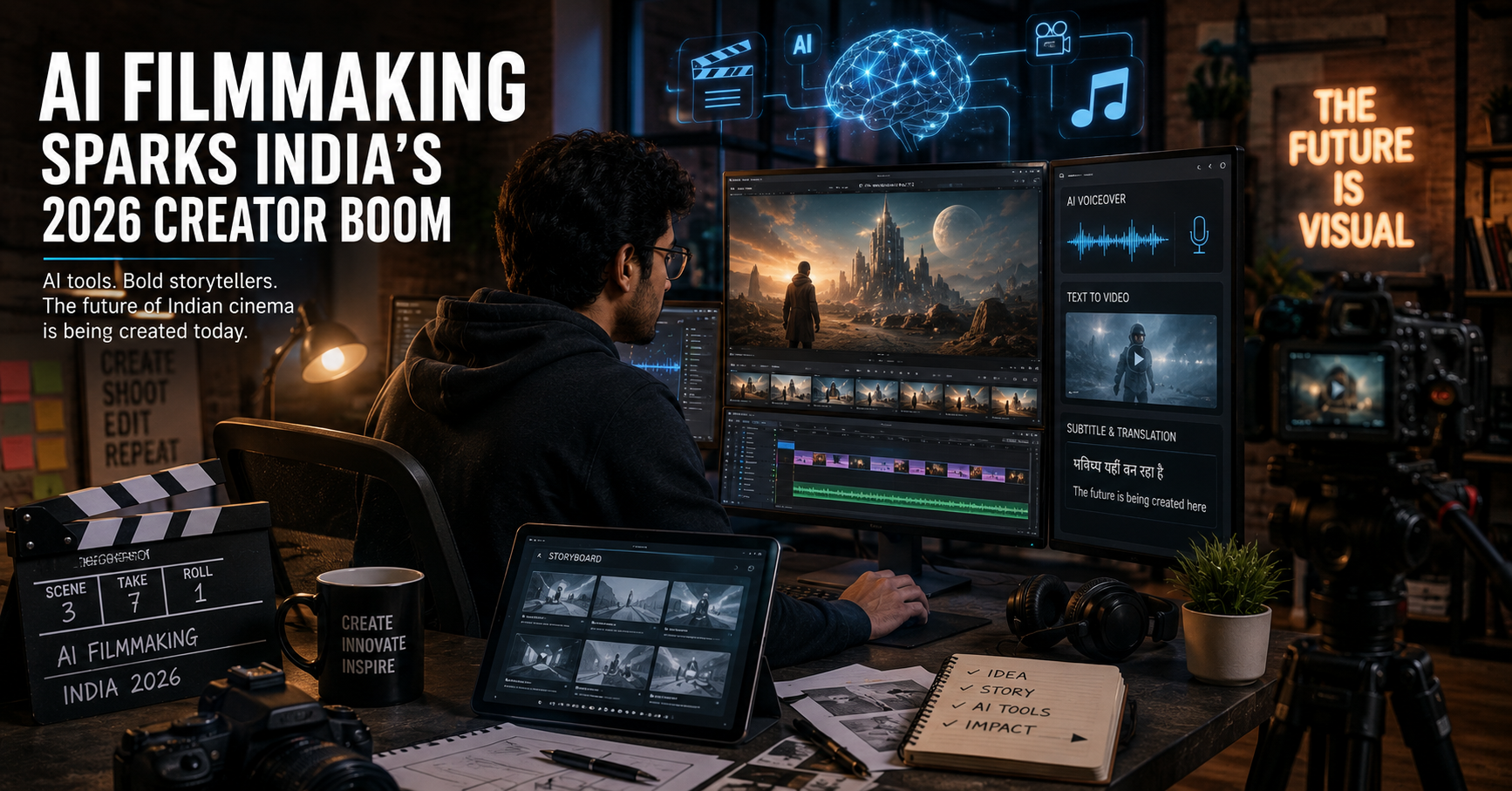
Artificial intelligence is rapidly transforming the way films, advertisements, music videos, and digital stories are being created in India. What was once considered an expensive and technically demanding industry is now becoming increasingly accessible to independent creators, small studios, influencers, educators, and digital entrepreneurs through AI-powered filmmaking tools.
Across India’s creator economy, AI-generated visuals, synthetic voice technology, automated editing platforms, virtual production systems, and text-to-video software are beginning to reshape how content is planned, produced, and distributed. Industry observers say the shift could become one of the biggest creative technology movements in the country over the next few years.
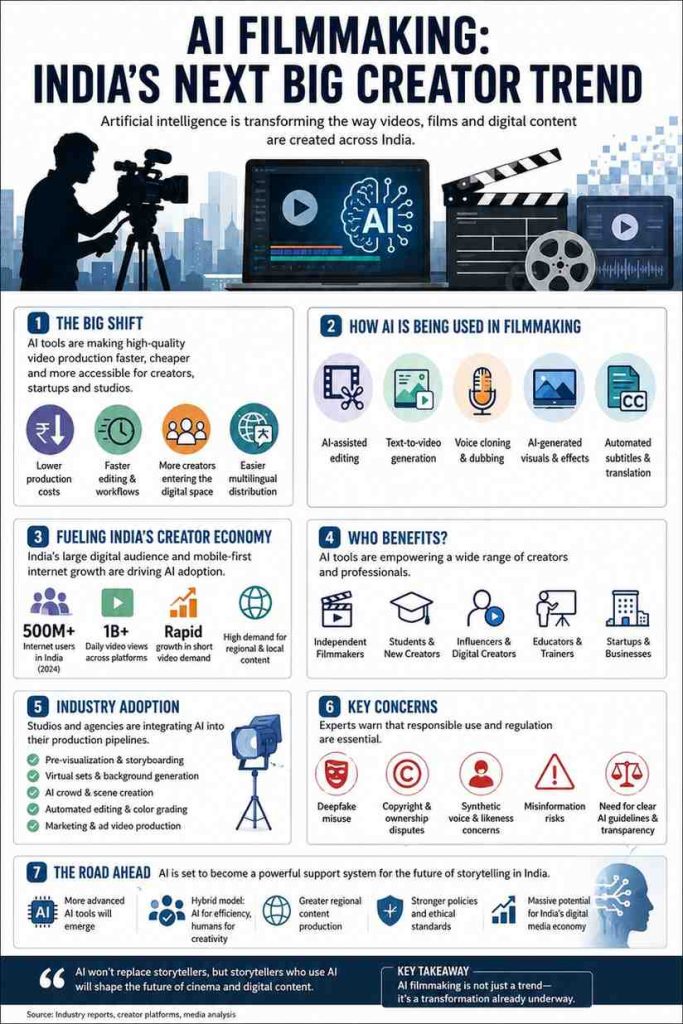
The growing adoption of AI filmmaking tools is being driven by several factors including lower production costs, easier access to advanced technology, increasing demand for short-form video content, and the rise of independent digital creators on platforms such as YouTube, Instagram, and OTT-based ecosystems.
While large production houses are experimenting with AI-assisted workflows, smaller creators are also entering the space at an unprecedented pace. With only a laptop, internet access, and subscription-based AI tools, creators can now generate cinematic scenes, visual effects, animated characters, voiceovers, subtitles, and promotional content that previously required full-scale production teams.
Industry analysts say India’s expanding digital audience and smartphone penetration are creating ideal conditions for AI-driven visual storytelling to grow rapidly.
A Shift in How Content Is Produced
Traditional filmmaking often involves significant investment in equipment, shooting locations, editing infrastructure, visual effects teams, and production logistics. AI tools are beginning to streamline several of these processes.
Creators are increasingly using generative AI platforms to create concept art, storyboard sequences, script drafts, motion graphics, AI avatars, and synthetic environments. Automated editing software can reduce hours of manual post-production work, while AI dubbing and translation tools are making regional and multilingual distribution easier.
The rise of text-to-video platforms has also attracted attention among digital creators who produce educational explainers, marketing campaigns, podcasts, gaming content, and short cinematic videos for social media.
In India’s rapidly evolving creator economy, speed and consistency have become critical. AI tools are helping creators produce content faster while experimenting with formats that were previously expensive or difficult to execute independently.
Several creators and production professionals say AI is not replacing filmmaking entirely but is instead becoming a collaborative production layer that improves efficiency.
Why India Is Becoming a Major AI Creator Market
India has one of the world’s fastest-growing digital creator ecosystems. Millions of users now consume video-first content daily across social media platforms, OTT services, and regional entertainment networks.
This demand is encouraging creators to produce larger volumes of content while maintaining visual quality and audience engagement. AI-powered creative tools are emerging as a solution for scaling production without proportionally increasing budgets.
India’s multilingual environment is another major factor. AI dubbing and voice synthesis technologies are helping creators localize content across Hindi, Telugu, Tamil, Bengali, Kannada, Malayalam, Marathi, and other regional languages.
This is especially significant for independent creators and startups trying to reach broader audiences without maintaining separate production teams for each language market.
Technology startups operating in generative AI, virtual production, and creator tools are also seeing increased investor interest. Many companies are building AI products specifically designed for Indian creators, advertisers, educators, and entertainment professionals.
Industry experts believe the next phase of growth may come from hybrid production models where AI handles repetitive or technical tasks while human creators focus on storytelling, direction, and emotional depth.
Film Studios and Advertising Agencies Are Experimenting Rapidly
AI filmmaking is no longer limited to small creators or experimental internet videos. Advertising agencies, media companies, and film production houses are increasingly testing AI-assisted workflows.
Some production teams are using AI for:
- pre-visualization
- script ideation
- background generation
- virtual set creation
- AI-assisted editing
- synthetic voiceovers
- automated subtitling
- multilingual adaptation
- digital crowd creation
Marketing agencies are also using AI-generated video campaigns to reduce turnaround times for social media advertising and branded content.
The technology is particularly attractive for low-budget productions and high-volume content operations where speed is commercially important.
At the same time, filmmakers are exploring AI-generated cinematic styles and virtual storytelling formats that blend animation, gaming aesthetics, and traditional cinema techniques.
Experts say India’s massive entertainment industry could become one of the world’s largest testing grounds for AI-driven storytelling models.
Concerns Around Authenticity and Creative Ownership
Despite the excitement surrounding AI filmmaking, concerns are also growing around ethics, copyright, misinformation, and creative authenticity.
Industry professionals have raised questions about:
- ownership of AI-generated content
- unauthorized use of actor likenesses
- deepfake misuse
- copyright disputes
- synthetic voice cloning
- job displacement fears
- transparency in AI-generated media
Some creators worry that excessive dependence on AI tools could reduce originality and increase repetitive visual trends online.
There are also broader concerns about misinformation. AI-generated videos can sometimes create highly realistic but misleading visuals, raising challenges for journalism, political communication, and public trust.
Several governments and technology regulators globally are now discussing AI disclosure frameworks and transparency guidelines for synthetic media.
In India, policy conversations around AI governance are gradually expanding as adoption accelerates across sectors.
Media analysts say responsible implementation will be crucial if AI filmmaking becomes mainstream within entertainment and digital communication industries.
The Creator Economy Is Driving the Movement
The strongest momentum behind AI filmmaking in India appears to be coming from the creator economy itself.
Independent creators are experimenting aggressively because AI tools reduce barriers to entry. Individuals who previously lacked access to professional cameras, studios, or editing teams can now produce visually sophisticated content with relatively limited resources.
This democratization of production technology is creating opportunities for:
- small-town creators
- student filmmakers
- educators
- digital marketers
- regional storytellers
- startup founders
- influencers
- freelancers
- independent animators
AI tools are also allowing creators to test ideas faster before investing in larger productions.
As competition intensifies across digital platforms, creators are under pressure to maintain output frequency while retaining audience attention. AI-assisted workflows are increasingly becoming part of that strategy.
Industry observers believe India’s young population and large internet user base may further accelerate experimentation with AI-generated entertainment formats.
Future of AI Cinema in India
The long-term future of AI filmmaking in India will likely depend on how technology, regulation, creativity, and audience trust evolve together.
While AI can automate technical processes and reduce production costs, storytelling remains deeply dependent on human emotion, cultural nuance, performance, and creativity. Many filmmakers argue that AI may become a tool that enhances production rather than fully replacing human artistic roles.
Educational institutions and film schools are also beginning to discuss AI-based creative training as part of future media education.
Meanwhile, technology companies continue launching increasingly advanced generative video systems capable of creating cinematic visuals from simple text prompts.
As tools improve, the distinction between independent creators and professional production environments may continue to narrow.
India’s entertainment and digital media sectors are expected to remain among the most closely watched markets in this transition because of the country’s scale, diversity, and rapidly expanding creator ecosystem.
The coming years may determine whether AI filmmaking becomes a supporting technology within the industry or a transformational force that permanently changes how visual storytelling is created, distributed, and consumed in India.
Highlights
- AI filmmaking tools are rapidly gaining popularity among Indian digital creators, filmmakers, and content producers.
- Generative AI platforms are helping creators reduce production costs and speed up editing, dubbing, and visual production workflows.
- India’s multilingual creator economy is driving demand for AI-powered localization and video production tools.
- Advertising agencies and production houses are increasingly experimenting with AI-assisted filmmaking techniques.
- Concerns around copyright, deepfakes, synthetic media, and creative authenticity continue to grow alongside adoption.
- Industry experts believe AI may reshape independent filmmaking and digital storytelling across India’s creator ecosystem.
- The technology is lowering barriers for small creators, student filmmakers, and regional content producers.
FAQ
What is AI filmmaking?
AI filmmaking refers to the use of artificial intelligence tools in film and video production. These tools can assist with script writing, editing, voiceovers, visual effects, subtitles, animation, and even generating video scenes from text prompts.
Why is AI filmmaking growing in India?
India’s rapidly expanding creator economy, large internet audience, and growing demand for digital video content are driving adoption. AI tools also help creators reduce production costs and work faster.
How are creators using AI in video production?
Creators are using AI for automated editing, multilingual dubbing, AI-generated visuals, subtitles, voice synthesis, virtual backgrounds, and content planning.
Can AI replace traditional filmmakers?
Most industry experts believe AI will support filmmaking rather than fully replace human creativity. Storytelling, emotional depth, acting, and cultural understanding still depend heavily on human involvement.
What concerns are associated with AI filmmaking?
Major concerns include copyright disputes, deepfake misuse, synthetic voice cloning, misinformation risks, and questions around ownership of AI-generated content.
Are film studios using AI tools already?
Yes. Some film studios, marketing agencies, and production companies are already experimenting with AI-assisted editing, virtual production, script visualization, and automated localization workflows.
How does AI help regional creators in India?
AI dubbing and translation technologies allow creators to distribute content across multiple Indian languages more efficiently and at lower cost.
Is the Indian government regulating AI-generated media?
India is still developing broader AI policy discussions. Globally, governments and regulators are increasingly examining transparency and disclosure standards for synthetic media.
Why does AI filmmaking matter for the creator economy?
AI tools lower technical and financial barriers, allowing independent creators and small teams to produce professional-quality content more easily.
What could happen next in AI filmmaking?
Experts expect more integration of AI into editing, production, animation, and multilingual distribution, while debates around ethics, originality, and regulation are likely to intensify.
Edited By E. Devanshi varma
Also Read: Assam Assembly Polls See 7 Major Highlights as Turnout Peaks, Counting Set for May 4
Follow us on Google News: Click Here