



A newly announced startup funding agreement has become one of the most discussed developments in the entrepreneurial and investment community, drawing attention from founders, venture capital firms, industry observers, and policymakers alike. While funding announcements are a routine occurrence in the startup ecosystem, certain deals attract broader attention because they reflect larger trends shaping the future of innovation, capital allocation, and business growth.
The latest funding transaction has generated conversations not only because of the size of the investment involved but also because of what it may indicate about investor confidence, sector priorities, and the evolving dynamics of startup financing. Across startup hubs, boardrooms, and investor networks, discussions have focused on whether the deal signals a renewed appetite for growth-stage investments or represents a more selective approach to backing companies with proven business models.
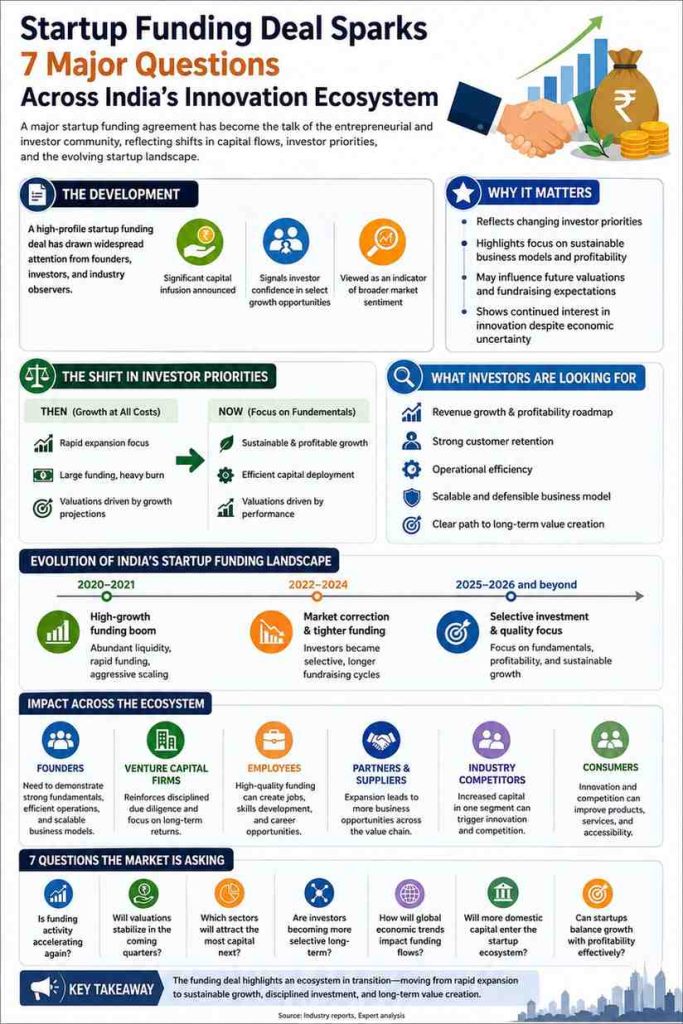
The development comes at a time when global startup funding markets continue to adapt to changing economic conditions. Over the past few years, entrepreneurs have faced a significantly different fundraising environment compared with the rapid investment boom witnessed during the low-interest-rate era. Investors have become increasingly focused on profitability, sustainable growth, efficient capital deployment, and clearer paths to long-term value creation.
Against this backdrop, major funding agreements are often viewed as indicators of broader market sentiment. Industry participants closely analyze such deals to understand where investment capital is flowing and which sectors are gaining momentum among venture capital firms and institutional investors.
A Shift in Investor Priorities
One of the most notable changes in recent years has been the transition from growth-at-all-costs strategies toward business fundamentals. During periods of abundant liquidity, startups frequently secured large investments based on aggressive expansion plans and projected market opportunities.
Today, investors are placing greater emphasis on measurable performance indicators. Revenue growth, customer retention, operational efficiency, and profitability timelines have become increasingly important factors in funding decisions.
The latest funding deal appears to reflect this broader shift. Analysts suggest that investors are now seeking companies capable of demonstrating resilience amid economic uncertainty while maintaining the ability to scale effectively.
This approach has altered fundraising conversations across industries. Founders are being encouraged to focus on sustainable growth rather than rapid expansion alone, leading many startups to rethink hiring plans, marketing expenditures, and market-entry strategies.
Why the Deal Is Attracting Attention
Several factors have contributed to the widespread discussion surrounding the funding agreement.
First, the investment arrives during a period when many startups have reported longer fundraising cycles. Securing significant capital under current market conditions is often interpreted as a sign of strong investor conviction.
Second, the deal highlights continued interest in innovation-driven businesses despite broader economic concerns. While funding activity has moderated compared with previous peaks, investors remain willing to support companies they believe possess strong competitive advantages and scalable business models.
Third, industry observers are examining whether the agreement could influence valuations across the startup ecosystem. Funding rounds involving high-profile companies often establish benchmarks that affect future negotiations between founders and investors.
The transaction has therefore become more than a company-specific event. It is being viewed as a potential signal regarding the direction of startup financing in the coming months.
India’s Startup Ecosystem Continues to Evolve
India has emerged as one of the world’s most dynamic startup markets, supported by a large consumer base, increasing digital adoption, expanding internet connectivity, and growing entrepreneurial activity.
Over the past decade, the country has witnessed the rise of numerous technology-driven companies operating across sectors including fintech, health technology, education technology, software services, e-commerce, logistics, artificial intelligence, and climate technology.
Government initiatives supporting innovation and digital transformation have also contributed to the expansion of startup activity. Improved access to technology infrastructure and growing participation from domestic investors have strengthened the overall ecosystem.
However, the funding landscape has undergone significant changes. Venture capital firms and private investors have become more selective, encouraging startups to demonstrate stronger financial discipline before raising additional capital.
The latest funding agreement arrives within this environment of cautious optimism. Investors continue to seek growth opportunities while maintaining a sharper focus on risk management and long-term sustainability.
What It Means for Founders
For startup founders, major funding announcements often provide valuable insight into investor expectations.
The current deal reinforces several themes that have become increasingly important in fundraising discussions. These include demonstrating clear product-market fit, maintaining operational efficiency, and building scalable business models capable of generating durable revenue streams.
Founders may also interpret the transaction as evidence that significant capital remains available for companies capable of meeting investor criteria. Although fundraising conditions have become more demanding, high-quality businesses continue to attract attention from both domestic and international investors.
At the same time, the deal serves as a reminder that securing funding is only one component of long-term success. Investors are placing greater emphasis on execution, governance standards, customer acquisition efficiency, and profitability pathways.
Implications for Venture Capital Firms
The agreement could also influence how venture capital firms evaluate future opportunities.
Investment firms frequently monitor notable transactions to assess market conditions and identify emerging trends. A high-profile funding round can encourage additional investment activity within related sectors if investors perceive strong growth potential.
Conversely, it may reinforce existing investment strategies centered on disciplined capital allocation and careful due diligence.
Many venture capital firms have spent recent years adapting to a more challenging investment environment. As a result, they are increasingly focused on portfolio quality, sustainable valuations, and long-term returns.
The latest transaction may therefore be viewed as part of a broader effort to identify businesses capable of delivering growth while managing risk effectively.
Sector-Wide Impact
Large funding deals often generate ripple effects beyond the companies directly involved.
Competitors may experience increased investor interest as funding activity highlights opportunities within a particular market segment. Suppliers, technology partners, and service providers can also benefit from increased business activity resulting from startup expansion.
In some cases, successful fundraising rounds contribute to job creation, research and development investments, and market innovation. These outcomes can strengthen entire industry segments and encourage further entrepreneurial activity.
Industry experts note that capital inflows play an important role in supporting innovation, particularly in sectors requiring significant investment in technology development and infrastructure.
The broader significance of the latest funding agreement will depend on how effectively the company utilizes the capital and whether the investment contributes to sustainable growth.
Looking Ahead
The startup funding environment remains closely tied to economic conditions, investor sentiment, and technological innovation. While uncertainty continues to influence global financial markets, investors remain interested in businesses capable of addressing real-world challenges and creating long-term value.
The attention surrounding the latest funding deal reflects a broader conversation about the future of entrepreneurship and innovation. Rather than focusing solely on the size of investments, market participants are increasingly evaluating how capital is deployed and whether businesses can achieve sustainable growth.
As startups, investors, and policymakers navigate the next phase of ecosystem development, funding agreements such as this one are likely to remain important indicators of market confidence and economic opportunity.
The coming months will reveal whether the deal represents an isolated success story or the beginning of a broader resurgence in startup investment activity. Either way, the transaction has already become a significant talking point within the innovation ecosystem, highlighting the evolving relationship between capital, technology, and entrepreneurship in a rapidly changing business environment.
Highlights
- A major startup funding agreement has sparked widespread discussion among founders, investors, and industry observers.
- The deal reflects growing investor focus on sustainable growth, profitability, and business fundamentals.
- Startup funding markets have become more selective compared with the rapid investment boom seen in previous years.
- Industry experts view the transaction as a potential indicator of broader investment sentiment and market confidence.
- The agreement highlights continued investor interest in innovation-driven businesses despite economic uncertainties.
- Founders may see the deal as evidence that strong companies can still attract significant capital in a cautious funding environment.
- The transaction could influence future startup valuations and investment strategies across the ecosystem.
FAQ
1. Why is this startup funding deal receiving so much attention?
The deal is attracting interest because it may reflect broader trends in investor sentiment, startup valuations, and funding priorities across the innovation ecosystem.
2. What does the funding agreement indicate about current investor behavior?
Investors are increasingly prioritizing sustainable growth, operational efficiency, profitability, and long-term business viability over rapid expansion alone.
3. How have startup funding conditions changed in recent years?
Fundraising has become more selective, with investors placing greater emphasis on business fundamentals, financial discipline, and measurable performance indicators.
4. What impact could the deal have on other startups?
High-profile funding rounds often influence investor interest, valuation expectations, and fundraising strategies for other companies operating in similar sectors.
5. Does this mean startup funding is recovering?
One deal alone does not confirm a broader recovery, but it may indicate continued investor willingness to support companies with strong business models and growth prospects.
6. Why are investors focusing more on profitability now?
Changing economic conditions and market realities have encouraged investors to prioritize sustainable returns and long-term value creation.
7. How does this affect startup founders seeking funding?
Founders may need to demonstrate stronger business fundamentals, efficient capital use, and a clear path to growth when approaching investors.
8. What role does startup funding play in innovation?
Funding enables companies to invest in technology, expand operations, hire talent, and develop products that can drive economic growth and innovation.
Edited By E. Devanshi varma
Also Read: IPL Honey-Trap Row Sparks 7 Big Questions Before Playoffs
Follow us on Google News: Click Here