


Building a successful company is often viewed as proof of innovation, determination, and economic contribution. For many entrepreneurs, Founder particularly those operating globally, business growth can open doors to international markets, investors, partnerships, and expansion opportunities. Yet for some founders, even a proven business track record does not automatically translate into immigration approval.
A recent case involving a startup founder reportedly denied a US visa despite having built a business valued at approximately $12 million has reignited discussions around immigration policies, entrepreneur mobility, and the challenges faced by founders seeking access to international markets.
The situation has drawn attention across startup communities, where many entrepreneurs argue that business success alone does not guarantee entry into countries with strict immigration requirements. While governments often promote innovation and foreign investment, visa decisions typically involve a broader set of legal and administrative criteria beyond revenue figures or company valuation.
Why the Case Has Attracted Attention
Entrepreneur-focused visa denials often generate significant interest because they highlight the intersection between immigration policy and economic growth. Founders frequently travel internationally to meet investors, attend conferences, negotiate partnerships, and explore expansion opportunities.
In this case, the reported denial has sparked debate because the founder had already achieved a notable business milestone. A company valuation of $12 million represents years of effort, investment, customer acquisition, and operational growth.
Supporters argue that entrepreneurs who create jobs and economic activity can contribute positively to host economies. Critics of the current system, however, note that immigration decisions are governed by legal frameworks rather than business achievements alone.
As a result, the case serves as a reminder that visa approvals depend on documentation, eligibility requirements, interview assessments, and compliance with immigration regulations.
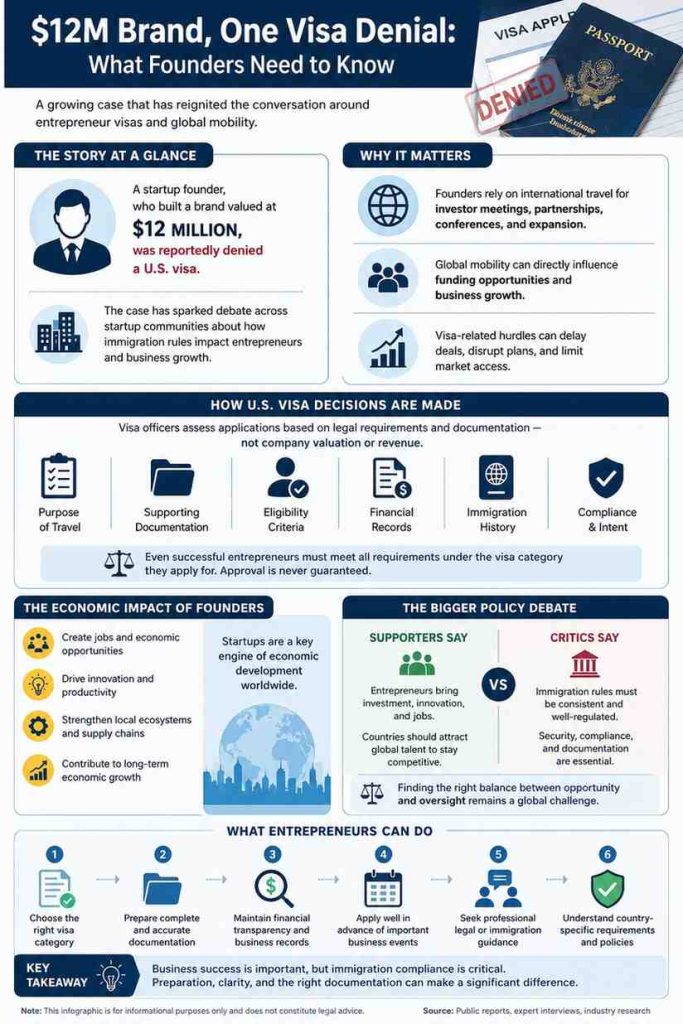
Understanding How US Visa Decisions Are Made
The United States operates one of the world’s most complex immigration systems. Depending on the purpose of travel, applicants may apply for different visa categories, including business visitor visas, investor visas, work visas, or entrepreneur-focused pathways.
Visa officers assess applications using established legal standards. Factors commonly reviewed may include:
- Purpose of travel
- Supporting documentation
- Financial records
- Previous travel history
- Immigration compliance
- Eligibility under the selected visa category
- Evidence supporting temporary or long-term intentions
Importantly, a successful business background does not automatically satisfy every visa requirement. Even founders with substantial revenues, investments, or company valuations must demonstrate compliance with applicable rules.
Immigration attorneys often advise entrepreneurs to prepare extensive documentation that clearly explains business activities, travel objectives, funding sources, and future plans.
The Growing Importance of Founder Mobility
The modern startup ecosystem is increasingly global. A founder based in one country may hire employees across multiple regions, secure funding from international investors, and serve customers worldwide.
As a result, international mobility has become a critical component of business growth.
Industry experts frequently point out that access to global markets can determine whether a startup remains regional or scales internationally. Business travel often plays an important role in securing partnerships, raising capital, and participating in innovation ecosystems.
When founders encounter visa-related obstacles, expansion plans can face delays. Meetings may need to be conducted virtually, networking opportunities may be lost, and negotiations can become more complicated.
While digital communication tools have reduced some barriers, face-to-face interaction remains highly valuable in many industries.
Challenges Faced by International Entrepreneurs
Entrepreneurs often operate under unique circumstances that do not always align neatly with traditional immigration categories.
Unlike conventional employees, founders may:
- Own significant equity in their companies
- Receive irregular compensation
- Manage international operations
- Travel frequently
- Work across multiple jurisdictions
These characteristics can sometimes create additional complexity during immigration reviews.
Startup founders have long advocated for immigration pathways designed specifically for entrepreneurs. Several countries have introduced startup visa programs intended to attract innovation-driven businesses and investment.
Such initiatives generally seek to balance economic opportunity with regulatory oversight.
Economic Impact of Startup Founders
Across the world, startups contribute to employment generation, technological innovation, and economic development.
Successful entrepreneurs often create ecosystems that extend beyond their own companies. Suppliers, service providers, consultants, contractors, and local communities may all benefit from growing businesses.
Research consistently shows that startups play an important role in introducing new products, improving productivity, and driving competition across industries.
For this reason, policymakers frequently examine whether immigration systems adequately support entrepreneurial talent while maintaining legal safeguards and national security requirements.
The broader debate is not simply about individual visa decisions. It also concerns how countries position themselves in a highly competitive global race for innovation and investment.
Startup Communities React
Cases involving entrepreneur visa denials often generate strong reactions from startup founders, investors, and business organizations.
Many in the startup community emphasize that company valuation alone should not determine immigration outcomes. At the same time, they argue that entrepreneurial achievements deserve consideration when evaluating applicants seeking business-related travel opportunities.
Some investors view founder mobility as a strategic issue because access to international markets can influence startup growth trajectories.
Others note that immigration officers must follow existing legal standards regardless of public perceptions or commercial success.
These differing viewpoints highlight the complexity of balancing economic interests with immigration enforcement responsibilities.
A Broader Policy Conversation
The reported case arrives at a time when countries around the world are competing to attract entrepreneurs, researchers, engineers, and technology professionals.
Governments increasingly recognize the role of innovation-driven businesses in economic growth. As a result, many jurisdictions have introduced programs targeting founders and startup teams.
Supporters of entrepreneur-friendly immigration pathways argue that welcoming innovators can generate long-term economic benefits. Opponents stress the importance of maintaining consistent eligibility standards and thorough review processes.
The debate is likely to continue as technology startups become more global and founders seek greater mobility across borders.
What Entrepreneurs Can Learn
Regardless of the outcome of any individual case, immigration specialists often recommend several best practices for founders seeking international travel approvals:
- Select the appropriate visa category
- Maintain comprehensive business records
- Prepare detailed travel documentation
- Demonstrate financial transparency
- Seek professional legal guidance when necessary
- Understand country-specific immigration requirements
- Apply well in advance of important business events
Preparation does not guarantee approval, but it can help reduce misunderstandings and strengthen applications.
For founders operating internationally, immigration compliance has become as important as financial planning, product development, and business strategy.
The reported denial underscores a reality faced by many entrepreneurs: commercial success and immigration eligibility are not always evaluated through the same lens. As governments continue refining policies aimed at balancing economic opportunity with regulatory oversight, founder mobility is expected to remain an important issue within the global startup ecosystem. The discussion sparked by this case extends beyond one entrepreneur and raises broader questions about how countries can support innovation while maintaining established immigration standards.
Highlights
- A startup founder reportedly faced a US visa denial despite building a business valued at around $12 million.
- The case has sparked discussion about how immigration policies affect entrepreneurs and startup growth.
- Visa approvals are typically based on legal eligibility requirements rather than business success alone.
- International mobility remains important for founders seeking investors, partnerships, and expansion opportunities.
- Startup communities continue to advocate for immigration pathways tailored to entrepreneurs.
- The situation highlights broader debates about innovation, economic contribution, and immigration policy.
FAQ
1. Why has this case attracted attention?
The reported denial involves a founder who built a multimillion-dollar company, raising questions about how entrepreneurial achievements are considered in immigration decisions.
2. Does business success guarantee a US visa?
No. Visa approvals depend on eligibility requirements, documentation, travel purpose, and immigration regulations.
3. What role do visas play in startup growth?
Visas can enable founders to attend meetings, seek funding, build partnerships, and explore international expansion opportunities.
4. Why do entrepreneurs face unique immigration challenges?
Founders often have ownership stakes, international operations, and unconventional income structures that may not fit traditional employment-based visa categories.
5. What is founder mobility?
Founder mobility refers to an entrepreneur’s ability to travel internationally for business, investment, networking, and operational purposes.
6. How do governments balance innovation and immigration controls?
Many governments seek to attract entrepreneurs while maintaining legal, security, and regulatory requirements within immigration systems.
7. Are there startup-specific visa programs?
Several countries offer entrepreneur or startup visa pathways designed to attract innovative businesses and investment.
8. What can founders do before applying for a visa?
Experts generally recommend maintaining detailed records, selecting the correct visa category, and ensuring strong supporting documentation.
Edited By E. Devanshi varma
Also Read: IPL Honey-Trap Row Sparks 7 Big Questions Before Playoffs
Follow us on Google News: Click Here