

Global tensions are cooling IPO activity, but private equity, strategic investments, and M&A are emerging as key growth funding channels for businesses in India and beyond.
The global initial public offering (IPO) market is facing renewed pressure as geopolitical uncertainty, market volatility, and investor caution reshape fundraising strategies. While IPO activity has not come to a halt, companies considering public listings are becoming more selective about timing, valuation expectations, and capital-raising options.
The trend is becoming increasingly visible across major markets, including India, where businesses are balancing strong economic growth prospects against a challenging international backdrop. As public-market conditions fluctuate, many companies are exploring alternative funding routes, highlighting a broader shift in how businesses approach growth and capital formation.
The discussion gained momentum following a LinkedIn News conversation around how global tensions are cooling the mainboard IPO market. The topic resonated with finance professionals and market participants who argue that the story extends beyond IPO slowdowns and reflects the growing sophistication of private capital markets.
IPO Momentum Meets Global Uncertainty
The IPO market entered 2026 with optimism in several regions as inflation concerns eased and expectations of lower interest rates improved investor sentiment. However, geopolitical developments, trade uncertainties, and broader economic risks have injected caution into public markets.
Historically, IPO activity tends to be highly sensitive to uncertainty. Companies planning public offerings often seek predictable market conditions to maximize valuations and attract investor demand. When volatility rises, firms frequently delay listings until market conditions become more favorable.
Despite these challenges, investor interest in new listings has not disappeared entirely. India’s IPO market, for example, continues to see activity across both SME and mainboard segments.
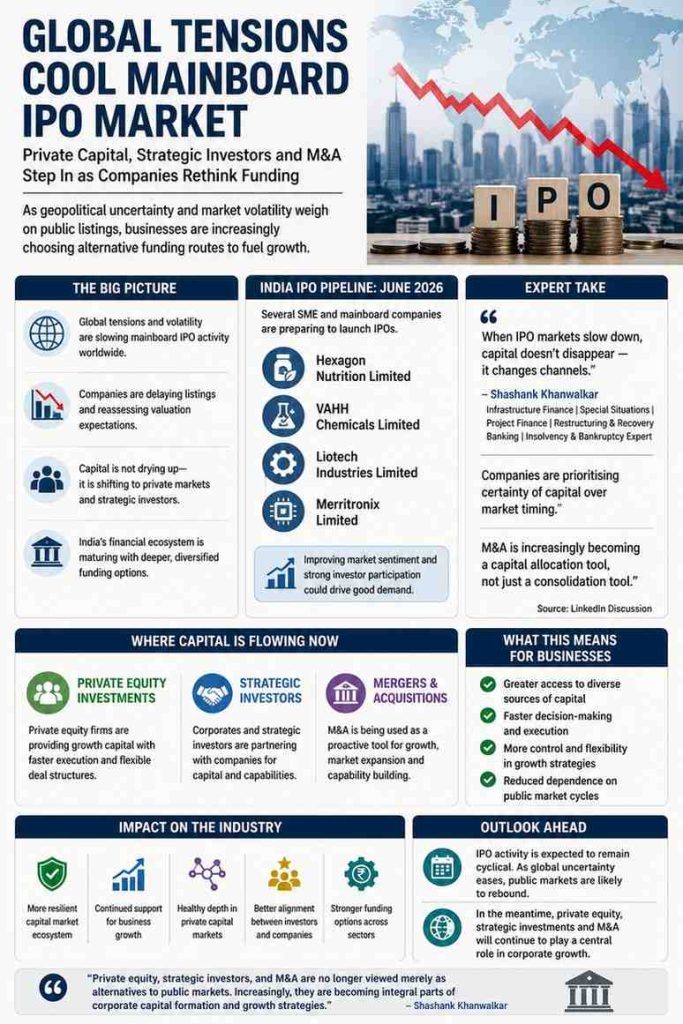
According to a market update shared by EQMINT, several companies are preparing to enter public markets in June 2026, including Hexagon Nutrition Limited, VAHH Chemicals Limited, Liotech Industries Limited, and Merritronix Limited. The update noted that improving market sentiment and continued investor participation could support demand for upcoming issues.
This contrast illustrates an important market reality: while global uncertainty may slow IPO activity, it does not necessarily eliminate investor appetite for quality businesses.
Beyond IPOs: The Rise of Alternative Capital
Many finance professionals argue that the more significant story is not the slowdown in public listings but the increasing availability of alternative funding sources.
Among those voices is Shashank Khanwalkar, a finance professional specializing in infrastructure finance, special situations, project finance, restructuring, recovery banking, and insolvency matters.
Reflecting on the changing market environment, Khanwalkar observed that companies are increasingly evaluating private equity investments, strategic capital partnerships, and mergers and acquisitions when public markets become less attractive.
“When IPO markets slow down, capital doesn’t disappear — it changes channels.”
His observation highlights a broader transformation occurring across financial markets. Businesses that might previously have relied heavily on IPOs for expansion funding now have access to a much wider range of capital providers.
Private equity firms, sovereign wealth funds, family offices, venture capital investors, and strategic corporate investors have significantly expanded their presence over the past decade. This diversification has reduced dependence on public markets as the sole avenue for large-scale fundraising.
Why Companies Are Choosing Capital Certainty
One of the strongest themes emerging from the current environment is the growing importance of capital certainty.
In uncertain markets, companies often prioritize securing funding over waiting for ideal public-market valuations. Delaying expansion plans while waiting for a favorable IPO window can create operational and competitive disadvantages.
Khanwalkar noted that companies are increasingly focused on certainty rather than timing.
“Companies are prioritising certainty of capital over market timing.”
This reflects a pragmatic approach among business leaders. Rather than remaining exposed to unpredictable market sentiment, firms are seeking financing solutions that provide immediate access to growth capital.
Private equity investors, for example, can often complete transactions more quickly than public offerings and may offer greater flexibility in deal structures. Strategic investors may also provide industry expertise, market access, and operational support in addition to funding.
For many businesses, these advantages can outweigh the prestige traditionally associated with a public listing.
M&A Emerges as a Strategic Growth Tool
Another notable development is the increasing role of mergers and acquisitions in corporate strategy.
Traditionally viewed as tools for consolidation, acquisitions are increasingly being used as mechanisms for capital deployment, market expansion, and business transformation.
Khanwalkar highlighted this shift, noting:
“M&A is increasingly becoming a capital allocation tool, not just a consolidation tool.”
This evolution reflects changing corporate priorities. Companies are pursuing acquisitions to gain technological capabilities, enter new markets, strengthen supply chains, and accelerate growth objectives.
In sectors ranging from technology and healthcare to manufacturing and financial services, strategic acquisitions are becoming central components of long-term growth plans.
As IPO markets experience periods of uncertainty, M&A activity often becomes more attractive because transactions can be negotiated privately without the pricing pressures associated with public offerings.
India’s Financial Ecosystem Continues to Mature
While short-term market conditions may affect fundraising activity, industry observers point to a more significant structural trend: the maturation of India’s capital ecosystem.
India’s financial markets have expanded substantially over the past decade. Regulatory improvements, greater institutional participation, deeper private capital pools, and increasing global investor interest have created a more diversified funding landscape.
According to Khanwalkar:
“Private equity, strategic investors, and M&A are no longer viewed merely as alternatives to public markets. Increasingly, they are becoming integral parts of corporate capital formation and growth strategies.”
This shift suggests that companies are adopting more sophisticated financing approaches. Rather than viewing IPOs as the ultimate destination, many businesses are treating public markets as one stage within a broader capital strategy.
The result is a more resilient financial ecosystem capable of supporting growth through multiple channels.
What This Means for Businesses and Investors
The evolving market environment presents both opportunities and challenges.
For businesses, the availability of multiple funding sources creates greater flexibility. Companies can select financing options that align with their growth objectives, ownership preferences, and market conditions.
For investors, increased private-market activity may provide opportunities to participate in high-growth companies before they reach public markets.
However, challenges remain. Private capital transactions often involve more complex negotiations, governance considerations, and long-term commitments. Additionally, prolonged uncertainty in global markets could continue to affect valuations across both public and private sectors.
Companies will need to carefully balance growth ambitions with capital efficiency, particularly as economic conditions remain fluid.
Future Outlook
Looking ahead, market participants expect IPO activity to remain cyclical. History suggests that public listings typically rebound when investor confidence improves and market volatility subsides.
The current environment does not necessarily indicate a structural decline in IPOs. Instead, it highlights the increasing diversity of capital-raising options available to modern businesses.
India’s pipeline of upcoming IPOs demonstrates that investor interest remains active, particularly for companies with strong fundamentals and clear growth stories. At the same time, private equity, strategic investments, and M&A activity are likely to continue expanding as important components of corporate finance strategies.
As global markets navigate ongoing geopolitical and economic challenges, the companies that succeed will likely be those capable of adapting their capital strategies to changing conditions.
Rather than viewing slower IPO activity as a sign of weakness, many industry professionals see it as evidence of a more mature financial ecosystem—one in which businesses have multiple pathways to growth, investment, and long-term value creation.
Key Takeaways
- Global geopolitical uncertainty is creating headwinds for IPO markets worldwide.
- India continues to maintain an active IPO pipeline despite broader market volatility.
- Companies are increasingly pursuing private equity and strategic investments alongside public-market options.
- Mergers and acquisitions are becoming important tools for growth and capital allocation.
- Businesses are prioritizing certainty of capital over waiting for ideal IPO windows.
- The trend reflects the growing maturity and diversification of India’s financial ecosystem.
- Alternative funding channels are complementing, rather than replacing, public markets.
Edited By E. Devanshi varma
Also Read: IPL Honey-Trap Row Sparks 7 Big Questions Before Playoffs
Follow us on Google News: Click Here