

India’s creator economy is undergoing a significant transformation. What began as a social media-driven ecosystem dominated by influencers chasing views and followers is evolving into a more structured digital industry built around entrepreneurship, monetization, audience ownership, and professional content businesses.
Over the past decade, platforms such as YouTube, Instagram, Facebook, and later short-video applications helped millions of Indians become content creators. However, the industry’s next phase is no longer defined solely by viral content. Instead, creators are increasingly focusing on sustainable revenue streams, niche communities, long-term brand building, and diversified digital businesses.
Industry observers believe this shift could have broader implications for advertising, e-commerce, media, education, and employment, as creators become increasingly influential in shaping consumer behavior and digital culture across India.
A Rapidly Expanding Digital Economy
India’s growing internet population has laid the foundation for the creator economy’s rise. Affordable smartphones, lower data costs, improved connectivity, and increasing digital literacy have enabled individuals from large metropolitan cities as well as smaller towns to build audiences online.
The creator ecosystem today extends far beyond entertainment. Content creators are active across education, finance, technology, health, gaming, lifestyle, travel, agriculture, entrepreneurship, and professional services. This diversification has broadened the industry’s economic impact and attracted attention from investors, advertisers, and technology platforms.
Brands are also changing how they allocate marketing budgets. Traditional advertising channels continue to play a role, but digital creators increasingly provide targeted audience access, authenticity, and measurable engagement that many companies find valuable.
Shift From Influencers to Digital Entrepreneurs
One of the most important developments in the creator economy is the evolution of creators into business operators.
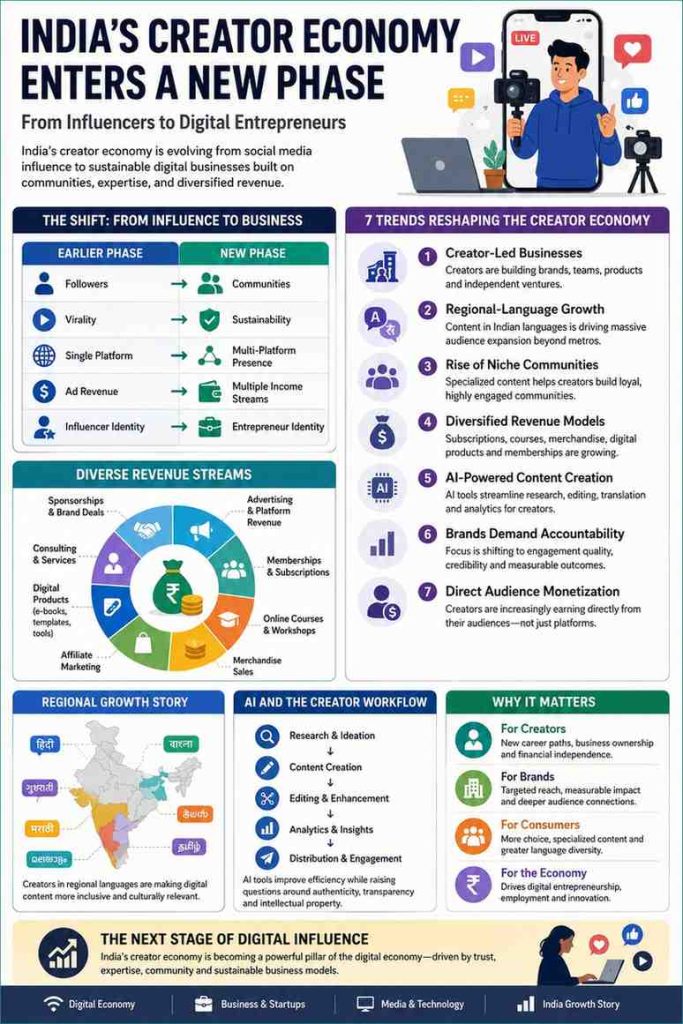
Many successful creators are no longer dependent on a single platform or advertising revenue source. Instead, they are building multi-channel businesses that include sponsorships, merchandise, subscriptions, consulting services, online courses, digital products, events, and direct audience memberships.
This entrepreneurial approach helps reduce dependence on platform algorithms, which can change unexpectedly and affect audience reach. It also creates more stable income opportunities and allows creators greater control over their businesses.
The trend reflects a broader maturation of the sector as creators increasingly adopt professional management structures, legal support, financial planning, and dedicated teams.
The Rise of Niche Content Communities
For years, success in social media was often measured by mass appeal and follower counts. The next phase of India’s creator economy is placing greater emphasis on niche expertise and community engagement.
Creators focusing on highly specialized topics are finding opportunities to build loyal audiences. Whether discussing stock markets, coding, fitness, regional cuisine, farming techniques, or personal finance, niche creators often generate stronger engagement than broader lifestyle accounts.
This shift benefits both creators and advertisers. Brands can connect with highly relevant audiences, while creators can establish authority within specific subject areas.
As consumers increasingly seek trustworthy and specialized information, expertise-driven content is becoming a powerful differentiator in a crowded digital landscape.
Regional Languages Become a Major Growth Driver
India’s linguistic diversity is playing an increasingly important role in the creator economy’s expansion.
While English-language content remains influential, regional-language creators are attracting substantial audiences across multiple platforms. Content produced in Hindi, Telugu, Tamil, Bengali, Marathi, Kannada, Malayalam, Gujarati, and other Indian languages continues to gain momentum.
The growth of regional content reflects broader internet adoption beyond major urban centers. As digital access expands, audiences increasingly prefer consuming information and entertainment in their native languages.
For brands and platforms, this trend presents opportunities to engage consumers in more culturally relevant and locally meaningful ways.
Regional creators are therefore expected to remain central to the next stage of digital growth in India.
Diversified Revenue Models Are Becoming Essential
Monetization remains one of the most important challenges and opportunities within the creator economy.
Previously, many creators relied heavily on advertising revenue or sponsored content. Today, diversification is becoming a necessity rather than a strategy.
Subscription models, paid communities, crowdfunding, affiliate marketing, digital products, workshops, and online learning programs are helping creators generate multiple income streams.
This evolution is creating a more resilient ecosystem where creators are less vulnerable to platform policy changes or fluctuations in advertising demand.
The emphasis on revenue diversification also reflects growing financial sophistication among creators who increasingly view content creation as a long-term profession rather than a side activity.
Artificial Intelligence Is Changing Content Creation
Artificial intelligence is emerging as one of the most influential forces shaping the future of the creator economy.
AI-powered tools are helping creators streamline editing, content planning, research, graphic design, subtitles, language translation, and audience analytics. These technologies can reduce production costs and improve operational efficiency.
At the same time, AI raises new questions around originality, authenticity, copyright, and misinformation. As AI-generated content becomes more common, audiences may place greater value on transparency and human expertise.
Industry experts expect creators who successfully combine technological efficiency with genuine audience trust to be best positioned for long-term growth.
The integration of AI into creator workflows is therefore likely to become a defining characteristic of the industry’s next chapter.
Brands Are Demanding Greater Accountability
As influencer marketing budgets continue to expand, companies are becoming more selective in their partnerships.
Brands increasingly evaluate creators using metrics beyond follower counts. Engagement quality, audience demographics, conversion performance, credibility, and brand alignment are becoming more important factors in partnership decisions.
This shift is encouraging creators to focus on authentic audience relationships rather than purely pursuing rapid follower growth.
Greater accountability is also contributing to improved transparency around sponsored content, disclosures, and advertising standards.
The result is a more professional ecosystem that benefits brands, creators, and consumers alike.
Opportunities Beyond Social Media
Another notable trend is the emergence of creator-led businesses outside traditional social platforms.
Many creators are launching direct-to-consumer brands, educational ventures, media companies, podcasts, newsletters, and subscription communities. Some are even building technology startups or investing in new business ventures.
This development highlights how creators are increasingly viewed not only as entertainers or influencers but also as founders and entrepreneurs.
The ability to convert audience trust into independent businesses may become one of the most significant economic outcomes of the creator economy’s evolution.
Why This Transition Matters
The creator economy’s transformation has implications that extend well beyond social media.
For young professionals, it creates alternative career pathways. For brands, it offers new marketing channels. For technology platforms, it drives user engagement and innovation. For consumers, it expands access to information, education, and entertainment tailored to specific interests and communities.
Perhaps most importantly, the next phase of India’s creator economy reflects a broader shift toward a digital-first economic model where individual expertise, audience trust, and community building can become valuable commercial assets.
As the ecosystem matures, success is likely to depend less on viral moments and more on sustainable business practices, credibility, and long-term audience relationships. India’s creator economy is no longer simply about content creation; it is increasingly becoming a powerful pillar of the country’s evolving digital economy.
Highlights
- India’s creator economy is evolving from influencer-driven growth to a more structured digital business ecosystem.
- Creators are increasingly building diversified revenue streams through subscriptions, merchandise, courses, and memberships.
- Regional-language content is becoming a major driver of audience growth across India’s expanding internet population.
- Brands are focusing more on engagement quality, audience relevance, and measurable outcomes rather than follower counts alone.
- Artificial intelligence is transforming content production while raising new questions around authenticity and trust.
- Niche creators are attracting loyal communities by offering specialized expertise and targeted content.
- The creator economy is creating new opportunities across media, education, e-commerce, advertising, and entrepreneurship.
FAQ
1. What is India’s creator economy?
India’s creator economy refers to the ecosystem of individuals who produce digital content and earn income through platforms, brand partnerships, subscriptions, products, services, and audience-supported models.
2. Why is the creator economy entering a new phase?
The sector is moving beyond follower-based influence toward sustainable business models, diversified income streams, and professional content operations.
3. What role do regional-language creators play in this growth?
Regional-language creators help platforms and brands reach audiences across different parts of India, particularly outside major metropolitan areas.
4. How are creators earning money today?
Many creators generate income through advertising, sponsorships, affiliate marketing, subscriptions, merchandise sales, digital products, consulting, and educational content.
5. Why are brands investing more in creator partnerships?
Creators often provide direct access to highly engaged audiences and can deliver targeted marketing outcomes with measurable performance metrics.
6. How is artificial intelligence affecting creators?
AI tools help improve efficiency in content production, editing, research, translation, and audience analysis, although concerns remain around authenticity and content ownership.
7. Are niche creators becoming more important?
Yes. Specialized creators often develop highly engaged communities and can establish authority within specific subject areas such as finance, technology, education, or health.
8. What challenges does the creator economy still face?
Key challenges include monetization consistency, platform dependency, content saturation, changing algorithms, regulatory considerations, and maintaining audience trust.
9. How does the creator economy affect the broader economy?
It contributes to digital entrepreneurship, employment opportunities, advertising growth, e-commerce activity, and the expansion of online education and media services.
10. What may define the future of the creator economy in India?
Long-term success is expected to be shaped by audience trust, diversified revenue models, technological adoption, and the ability to build sustainable digital businesses.
Edited By E. Devanshi varma
Also Read: IPL Honey-Trap Row Sparks 7 Big Questions Before Playoffs
Follow us on Google News: Click Here