

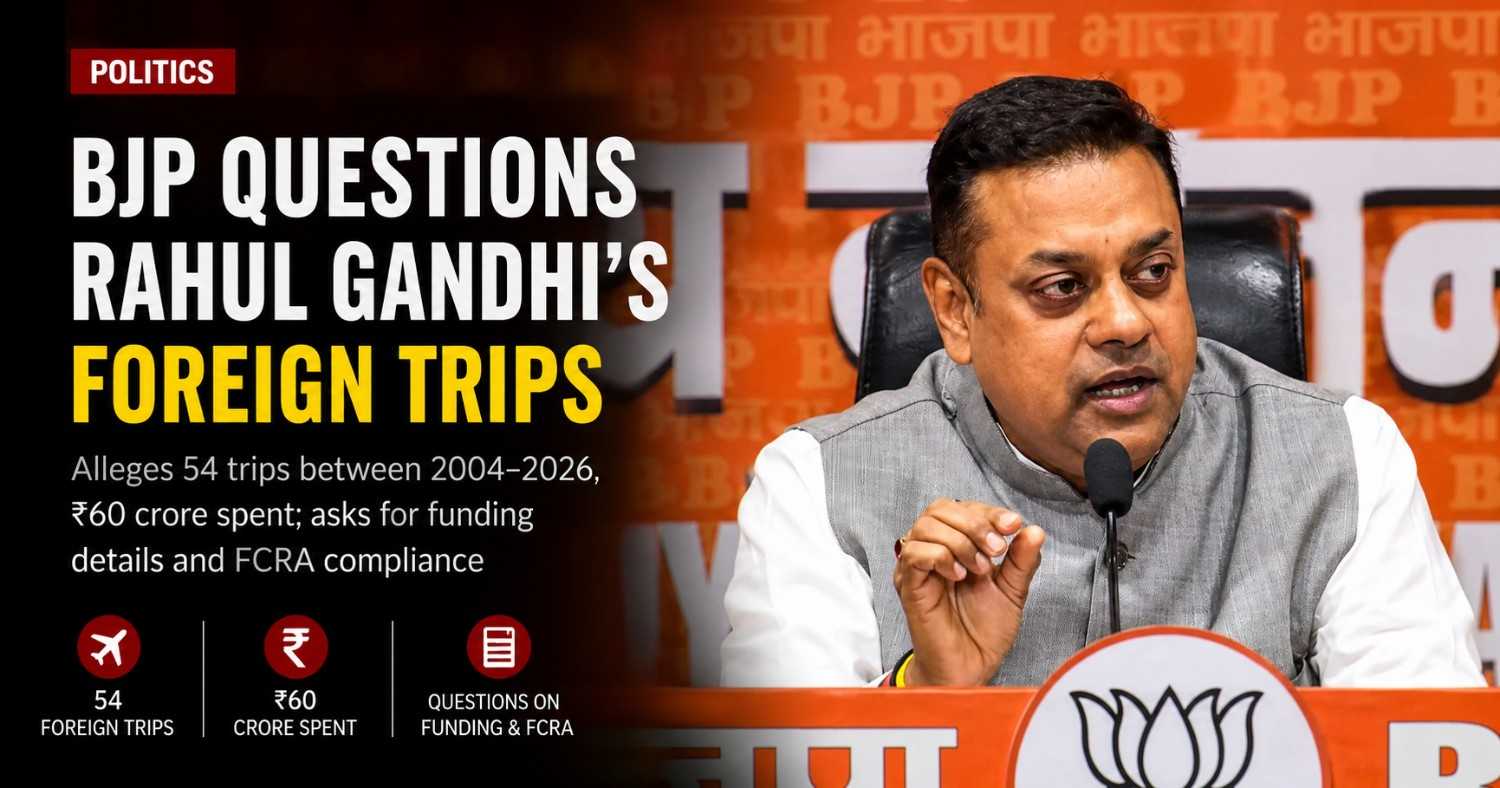
BJP alleges nearly ₹60 crore was spent on Rahul Gandhi’s overseas visits between 2004 and 2026, while Congress has yet to respond publicly to the latest claims.
New Delhi: A fresh political confrontation has erupted between the Bharatiya Janata Party (BJP) and the Congress after the ruling party raised questions over the funding and disclosure of foreign trips undertaken by Congress leader and Leader of Opposition in the Lok Sabha, Rahul Gandhi.
Addressing a press conference in New Delhi on Thursday, BJP spokesperson and Member of Parliament Sambit Patra alleged that Rahul Gandhi undertook 54 foreign trips between 2004 and 2026, spending nearly ₹60 crore during the period. Patra claimed that the financial details and sources of funding for these visits have not been disclosed publicly.
The BJP’s remarks come amid continuing political tensions between the two national parties ahead of key political developments and electoral contests. The allegations also attempt to shift focus toward issues of transparency, financial disclosure, and compliance with laws governing public representatives.
BJP Questions Funding Sources of Overseas Visits
During the media briefing at the BJP headquarters, Sambit Patra said that Rahul Gandhi travelled extensively to countries including the United States, Italy, the United Kingdom, Germany, Vietnam, Cambodia, Singapore, Bahrain, the Maldives, Qatar, the United Arab Emirates, and Oman.
According to Patra, public records such as press itineraries, parliamentary schedules, photographs, and media coverage confirm the existence of many of these trips. However, he claimed that the funding sources behind the travel expenses remain unclear.
The BJP spokesperson argued that there was a noticeable gap between Rahul Gandhi’s declared income and the estimated expenditure on international travel.
Patra stated that Rahul Gandhi’s declared income between the financial years 2013-14 and 2022-23 was around ₹11 crore. In comparison, the BJP estimated the cumulative cost of foreign travel during the broader 2004-2026 period at approximately ₹60 crore.
The BJP leader alleged that this difference raises legitimate questions regarding the source of funding and whether any foreign hospitality rules were followed.
Specific Trips Highlighted by BJP
The BJP also highlighted several individual foreign visits to support its allegations.
According to Sambit Patra, Rahul Gandhi’s 2015 Southeast Asia tour allegedly cost around ₹4.5 crore, while his declared income for that year was approximately ₹86.55 lakh. Patra questioned how such expenses were financed.
The BJP further claimed that Rahul Gandhi’s December 2025 trip to London and Berlin cost around ₹1.4 crore. Another visit to Latin American countries during September and October 2025 was estimated by the party to have cost nearly ₹5.5 crore.
Patra also referred to Rahul Gandhi’s reported April 2025 visit to Boston, which the BJP alleged cost approximately ₹1.2 crore.
In addition, the ruling party questioned two specific visits that it described as “undeclared” — an April 2025 trip to Dubai and a May 2026 visit to Muscat in Oman.
The BJP claimed that Central Reserve Police Force (CRPF) communication letters linked to these visits did not contain complete details regarding the itinerary, host organisations, or official programme schedules.
Questions Raised Over Foreign Hospitality Rules
A significant part of the BJP’s argument focused on legal provisions related to foreign hospitality and public officeholders.
Patra referred to provisions linked to the Foreign Contribution Regulation Act (FCRA) and related rules governing public representatives. He said Members of Parliament and individuals holding public office are required to seek prior approval before accepting hospitality or sponsorship from foreign entities.
The BJP asked whether Rahul Gandhi had received financial assistance, sponsorship, or hospitality from any foreign organisation, institution, or government during these trips.
The party demanded that relevant approvals, permissions, and expenditure records should be made public if any foreign-funded hospitality was involved.
Patra also said that if the trips were financed personally, then supporting documents such as bank statements, foreign exchange transaction records, or party expenditure details should be disclosed for transparency.
Allegations Related to Security Protocols
The BJP additionally referred to an alleged communication from the CRPF addressed to Congress president Mallikarjun Kharge.
According to Patra, the communication mentioned six “undeclared” foreign visits between December 2024 and September 2025 where complete security protocols were allegedly not followed.
The BJP leader argued that security agencies are required to maintain detailed information regarding overseas travel undertaken by leaders holding high-security protection status. He claimed that insufficient disclosure could potentially affect standard security procedures.
However, the BJP did not release detailed documentary evidence publicly during the press conference to independently verify all expenditure figures or allegations made regarding protocol violations.
Congress Yet to Respond Officially
As of Thursday evening, the Congress had not issued an official response to the BJP’s latest allegations regarding Rahul Gandhi’s foreign travel expenses.
The Congress has previously accused the BJP of attempting to divert attention from governance and economic issues by targeting opposition leaders through political campaigns and media briefings.
Rahul Gandhi, who currently serves as the Leader of Opposition in the Lok Sabha, has frequently travelled abroad for lectures, academic interactions, diaspora meetings, policy discussions, and private engagements over the years. Several of his foreign visits have attracted political attention in the past, especially during periods of active parliamentary sessions or major domestic political developments.
In earlier instances, Congress leaders defended such visits by describing them as part of international outreach, academic participation, or personal travel.
Political Context Behind the Allegations
The latest controversy emerges at a time when both the BJP and Congress are intensifying political attacks against each other ahead of upcoming legislative and electoral battles.
The BJP has increasingly focused on issues related to financial transparency, accountability, and foreign associations involving opposition leaders. Congress, on the other hand, has repeatedly accused the ruling party of using investigative narratives and political messaging to weaken opposition voices.
Rahul Gandhi remains one of the BJP’s principal political targets due to his prominent role within the Congress and his aggressive criticism of the central government on issues such as unemployment, economic inequality, democratic institutions, and social justice.
Political analysts note that controversies involving foreign visits often become politically sensitive because they intersect with questions of transparency, national security, and public accountability. At the same time, opposition parties frequently argue that such allegations are selectively raised for political advantage.
Why the Issue Matters
The debate around Rahul Gandhi’s foreign trips goes beyond political rivalry and touches upon broader questions related to disclosure norms for public representatives.
In India, elected leaders and constitutional officeholders are expected to maintain transparency regarding assets, financial interests, and certain forms of foreign engagement. Questions surrounding overseas travel expenses can become politically significant when there are concerns about sponsorship, foreign hospitality, or undisclosed financial arrangements.
At the same time, there is no blanket restriction preventing MPs or opposition leaders from travelling abroad for personal, political, academic, or professional reasons, provided legal and procedural requirements are followed where applicable.
The controversy is therefore likely to fuel further political exchanges over accountability and transparency standards for public figures.
With Parliament sessions and political campaigning expected to intensify in the coming months, the issue could continue to dominate political discourse if additional documents, clarifications, or official responses emerge from either side.
Key Insights
- The controversy highlights the growing political focus on transparency and financial disclosure standards for elected representatives, especially senior opposition leaders holding constitutional positions such as the Leader of Opposition in the Lok Sabha.
- Questions related to foreign hospitality and overseas sponsorships are legally sensitive in India because public officeholders may be required to comply with disclosure and approval provisions under laws linked to foreign contributions and official security protocols.
- The issue also reflects how international travel by high-profile political leaders has increasingly become part of domestic political scrutiny, particularly when trips coincide with parliamentary sessions, election cycles, or major political developments.
- While the BJP has raised allegations regarding funding sources and undeclared travel details, the absence of publicly released documentary evidence at this stage means the claims are likely to remain part of a broader political debate unless independently verified records emerge.
- The controversy could intensify demands for clearer disclosure mechanisms related to foreign travel undertaken by MPs and political leaders, including sponsorship declarations, itinerary transparency, and compliance documentation.
- Security protocol concerns raised in the matter are significant because protectees under central security cover generally require advance coordination with security agencies during overseas visits to ensure risk assessment and logistical preparedness.
- The episode underlines the increasingly aggressive political communication strategies adopted by both the BJP and Congress, where issues of governance, accountability, and personal conduct are becoming central themes ahead of future electoral contests.
- Political analysts note that allegations involving foreign links or overseas engagements often gain wider public attention in India because they intersect with concerns around national security, transparency, and political credibility.
- The Congress response, if issued in detail, could become crucial in shaping the next phase of the debate, particularly if financial records, approvals, or clarifications regarding specific trips are made public.
- The development is also likely to sustain media and parliamentary attention in the coming weeks, especially if either side releases additional documents, correspondence, or legal interpretations connected to the allegations.
Inputs and images : Hindusthan Samachar
Edited By E. Devanshi varma
Also Read: Assam Assembly Polls See 7 Major Highlights as Turnout Peaks, Counting Set for May 4
Follow us on Google News: Click Here