


Artificial intelligence has moved beyond being a futuristic concept and has become one of the most influential forces shaping the global economy Startups. While the technology sector has experienced periods of uncertainty over the past few years, Investors interest in AI startups continues to remain remarkably strong. Venture capital firms, institutional investors, technology giants, and private funding groups are still committing billions of dollars to companies developing AI-driven solutions across industries.
The sustained enthusiasm raises an important question: why are investors continuing to place significant bets on AI startups despite growing competition, valuation concerns, and an increasingly crowded marketplace?
The answer lies in the transformative potential of artificial intelligence and the belief that the technology remains in the early stages of a long-term growth cycle. Many investors view today’s AI ecosystem as comparable to the early years of the internet, cloud computing, and mobile technology—periods that eventually created some of the world’s most valuable companies.
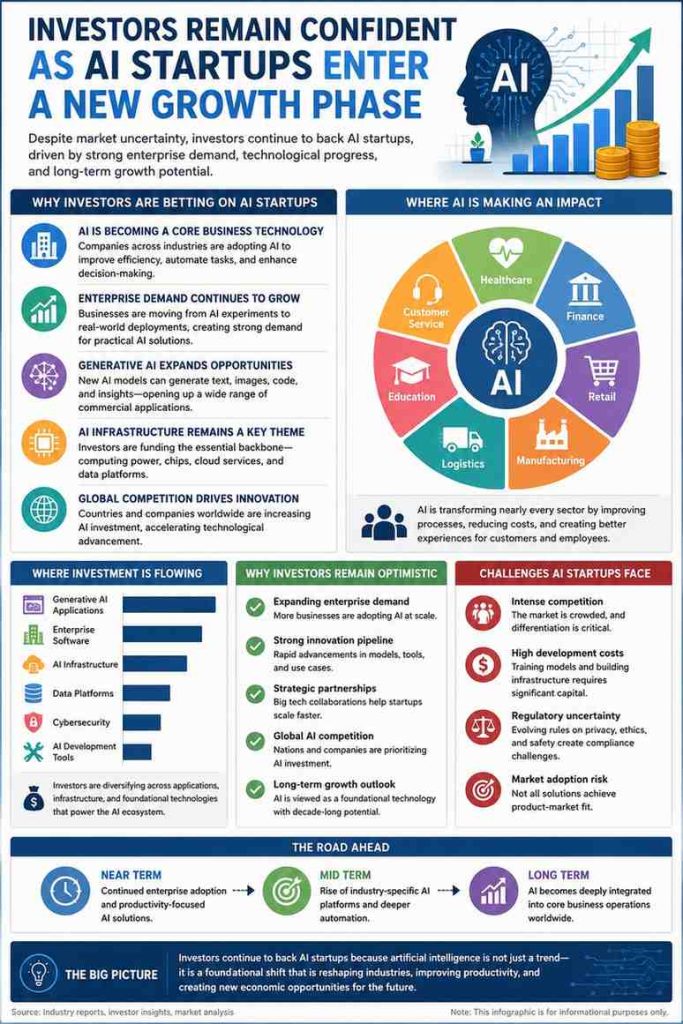
AI Is Becoming a Core Business Technology
One of the strongest factors supporting investor confidence is the rapid adoption of AI across industries. Businesses are increasingly integrating artificial intelligence into their operations to improve efficiency, automate repetitive tasks, analyze data, and enhance customer experiences.
From healthcare and finance to manufacturing, logistics, education, and retail, organizations are investing heavily in AI-powered tools. This broad adoption creates substantial market opportunities for startups that can develop specialized solutions tailored to industry-specific challenges.
Unlike previous technology trends that were limited to particular sectors, AI has demonstrated the ability to influence nearly every aspect of business operations. Investors see this widespread applicability as a sign that demand for innovative AI products is likely to continue expanding.
Enterprise Demand Continues to Grow
Businesses are no longer experimenting with AI solely for research purposes. Increasingly, organizations are deploying AI systems in real-world environments to improve productivity and reduce operational costs.
Companies are using AI to automate customer support, optimize supply chains, detect fraud, generate content, assist software development, and improve decision-making processes. As enterprise spending on AI solutions grows, startups offering practical business applications are attracting significant investor attention.
Many venture capital firms are prioritizing startups that generate recurring revenue through software subscriptions and enterprise contracts. These business models often provide greater financial stability and clearer paths toward profitability.
The Generative AI Boom Has Expanded Opportunities
The rise of generative AI has created a new wave of startup activity. Tools capable of generating text, images, videos, audio, software code, and business insights have expanded the range of commercial opportunities available to entrepreneurs.
Investors recognize that generative AI is not limited to consumer applications. Businesses are increasingly adopting these technologies to streamline workflows, accelerate content production, improve research processes, and enhance productivity.
As a result, funding is flowing not only to companies building foundational AI models but also to startups creating specialized applications on top of existing AI infrastructure. This layered ecosystem has broadened the investment landscape considerably.
AI Infrastructure Remains a Major Investment Theme
While much public attention focuses on AI applications, investors are also heavily backing companies that provide the infrastructure supporting artificial intelligence systems.
The growing demand for computing power, cloud services, data management tools, cybersecurity solutions, and AI chips has created opportunities throughout the technology supply chain.
Startups developing technologies that enable AI deployment often benefit from long-term demand regardless of which consumer-facing applications ultimately dominate the market. This infrastructure-focused approach provides investors with additional ways to participate in AI growth while diversifying risk.
Global Competition Is Accelerating Innovation
Countries around the world are increasing investments in artificial intelligence as governments recognize its economic and strategic importance. National AI initiatives, research programs, and public-private partnerships are contributing to rapid technological advancement.
This global competition has created an environment where innovation is accelerating at an unprecedented pace. Startups are developing new models, improving efficiency, reducing costs, and identifying novel use cases for AI technologies.
For investors, this competitive landscape signals that AI is likely to remain a priority area for technological development over the coming decade. The expectation of continued innovation helps sustain investment activity even during periods of market volatility.
Investors Are Looking Beyond Short-Term Market Cycles
Technology investment trends often experience periods of excitement followed by corrections. However, many experienced investors evaluate AI through a long-term lens rather than focusing exclusively on short-term market fluctuations.
Artificial intelligence is widely viewed as a foundational technology capable of reshaping industries and creating entirely new markets. As a result, investors are willing to tolerate near-term uncertainty if they believe a startup has the potential to become a significant player in the future AI economy.
This perspective is particularly common among venture capital firms, which often invest with time horizons extending five to ten years or longer.
Strong Talent Pools Are Driving Confidence
Another reason investors continue supporting AI startups is the concentration of highly skilled talent entering the field. Advances in machine learning research, increased availability of educational resources, and growing industry demand have attracted engineers, researchers, and entrepreneurs from around the world.
Many startups are being founded by professionals with experience at leading technology companies, academic institutions, and research organizations. Investors often view strong founding teams as one of the most important indicators of future success.
The availability of experienced AI talent helps strengthen confidence that innovative products can be developed and commercialized effectively.
Strategic Partnerships Are Creating Growth Opportunities
Large technology companies have become increasingly active participants in the AI ecosystem. Many are investing directly in startups, providing cloud infrastructure, offering development tools, and establishing partnership programs.
These relationships can provide emerging companies with access to customers, technical resources, and market visibility that might otherwise take years to achieve independently.
For investors, strategic partnerships can serve as validation that a startup’s technology has commercial relevance. Such collaborations may also increase acquisition opportunities, creating potential exit pathways for early investors.
Regulatory Developments Are Bringing Greater Clarity
As artificial intelligence becomes more widespread, governments and regulators are working to establish frameworks governing its development and use. While regulatory oversight can create compliance challenges, many investors believe clear rules may ultimately benefit the industry.
Well-defined regulations can help reduce uncertainty, establish industry standards, and build public trust in AI technologies. Companies that proactively address transparency, privacy, security, and ethical considerations may be better positioned to succeed in a regulated environment.
Investors increasingly evaluate how startups approach responsible AI practices as part of their broader risk assessment processes.
Not Every AI Startup Will Succeed
Despite the optimism surrounding artificial intelligence, investors remain aware that the sector faces challenges. Competition is intense, development costs can be high, and many startups may struggle to differentiate themselves in crowded markets.
Valuation concerns have also emerged as funding activity has accelerated. Some analysts warn that certain companies could face pressure if growth expectations fail to match market realities.
However, experienced investors generally recognize that transformative technologies often produce both winners and losers. Their objective is not to identify every successful company but to support startups with strong technology, capable leadership, and sustainable business models.
A Long-Term Bet on Technological Transformation
The continued flow of investment into AI startups reflects more than enthusiasm for a single technology trend. It represents a broader belief that artificial intelligence will play a central role in shaping the future of business, society, and economic growth.
While market conditions may fluctuate and competitive pressures will continue to intensify, investors see AI as a foundational innovation capable of generating value across multiple industries. Companies that successfully translate advanced AI capabilities into practical, scalable solutions are likely to remain attractive investment targets.
For many investors, the question is no longer whether artificial intelligence will transform industries, but which startups will emerge as the leaders of that transformation. That belief continues to drive funding activity and reinforces confidence that the AI startup ecosystem still has significant room for growth in the years ahead.
Highlights
- Investor interest in AI startups remains strong despite increasing competition and valuation concerns.
- Businesses across industries are adopting AI tools to improve efficiency, automation, and decision-making.
- Generative AI has expanded opportunities beyond traditional software and analytics applications.
- AI infrastructure companies are attracting funding alongside startups building end-user products.
- Strategic partnerships with major technology firms are helping startups accelerate growth.
- Regulatory developments are expected to provide greater clarity and support responsible AI adoption.
- Investors continue viewing AI as a long-term technological transformation rather than a short-term trend.
FAQ
1. Why are investors continuing to fund AI startups?
Investors believe artificial intelligence has the potential to transform multiple industries, creating significant long-term business opportunities and economic value.
2. Which sectors are adopting AI most rapidly?
Healthcare, finance, retail, manufacturing, logistics, education, and customer service sectors are among the fastest adopters of AI technologies.
3. What is driving growth in generative AI?
Generative AI tools can create content, code, images, videos, and business insights, making them valuable for both consumers and enterprises.
4. Are investors only funding AI applications?
No. Significant investment is also flowing into AI infrastructure, including computing resources, cloud platforms, semiconductor technologies, and cybersecurity solutions.
5. What risks do AI startups face?
Major challenges include intense competition, high development costs, regulatory requirements, and the need to establish sustainable business models.
6. How important are strategic partnerships for AI startups?
Partnerships with large technology companies can provide startups with access to customers, infrastructure, funding, and market credibility.
7. Will regulation slow AI investment?
Many investors believe clear regulations could strengthen trust in AI systems and support sustainable industry growth over the long term.
8. Is AI considered a long-term investment trend?
Yes. Most investors view AI as a foundational technology similar to the internet or cloud computing, with growth potential extending over many years.
Edited By E. Devanshi varma
Also Read: IPL Honey-Trap Row Sparks 7 Big Questions Before Playoffs
Follow us on Google News: Click Here