

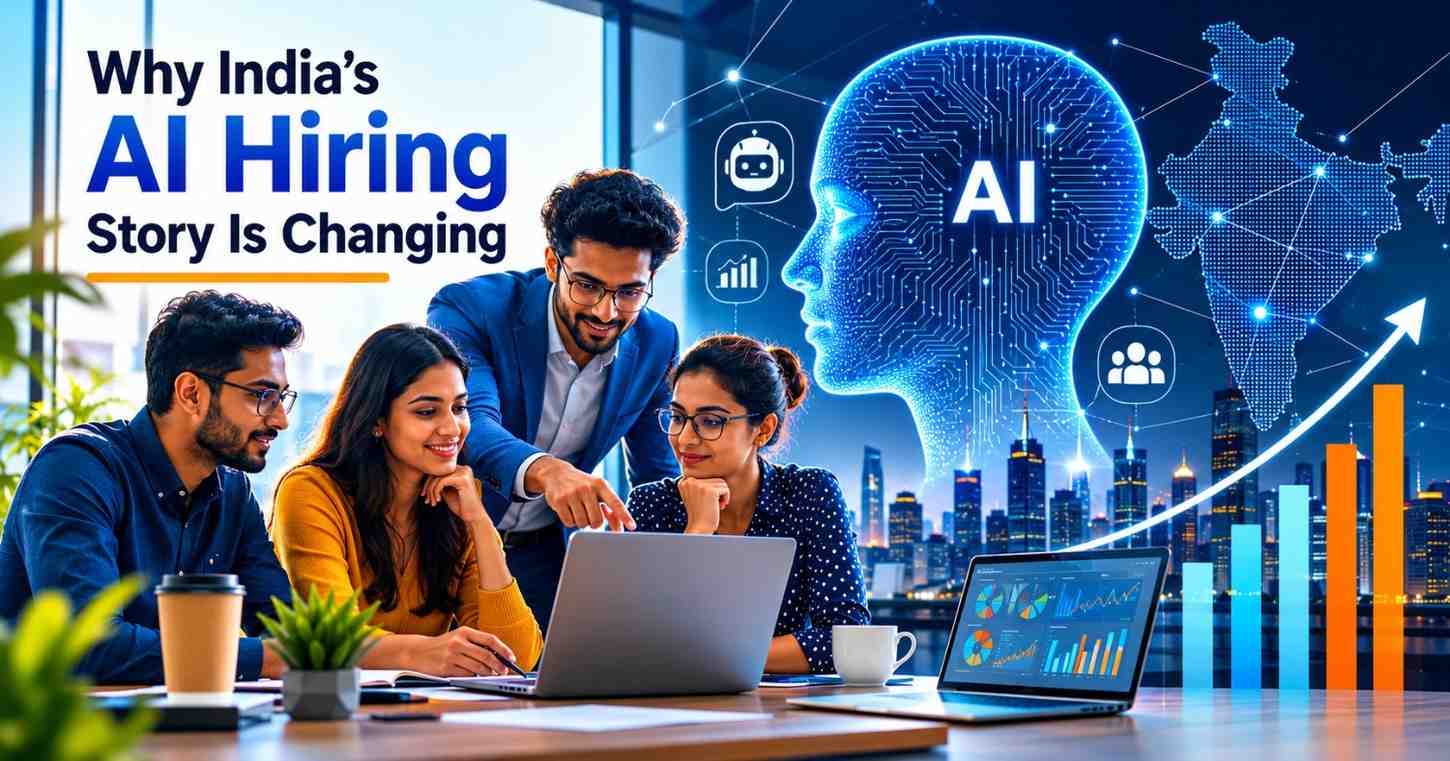
India’s artificial intelligence hiring landscape is undergoing a significant transformation. For several years, demand for AI talent appeared almost limitless as companies across sectors rushed to adopt automation, machine learning, generative AI, and data-driven decision-making. However, the hiring story in 2026 looks notably different from the rapid expansion phase witnessed just a few years ago.
Organizations are no longer pursuing AI recruitment solely to keep pace with industry trends. Instead, businesses are becoming more selective about the roles they create, the skills they prioritize, and the outcomes they expect from AI investments. This shift is reshaping employment opportunities across India’s technology sector and influencing how professionals prepare for future careers.
While AI remains one of the country’s most promising growth areas, hiring patterns indicate a move toward maturity rather than unchecked expansion. Companies are increasingly focused on practical applications, measurable returns, and workforce efficiency, leading to new opportunities as well as fresh challenges for job seekers.
A New Phase for India’s AI Economy
India has emerged as one of the world’s fastest-growing digital economies, supported by a strong technology services industry, a large engineering workforce, and increasing investments in digital infrastructure. Artificial intelligence has become a central part of this transformation.
Major enterprises, startups, financial institutions, healthcare providers, retailers, and manufacturing firms are actively integrating AI into their operations. However, as adoption becomes more widespread, organizations are moving beyond experimentation.
Instead of hiring large numbers of AI professionals simply to build innovation teams, employers are increasingly looking for specialists capable of delivering business outcomes. The result is a hiring environment where quality, experience, and domain expertise often matter more than workforce size.
Trend 1: Companies Are Prioritizing Specialized Talent
One of the most visible changes in AI hiring is the growing preference for specialized professionals.
In the early stages of AI adoption, organizations frequently sought general-purpose data scientists and machine learning engineers. Today, employers are searching for candidates with expertise in specific domains such as generative AI, large language models, computer vision, cybersecurity, healthcare analytics, and financial modeling.
This shift reflects the increasing complexity of AI deployments. Businesses require professionals who can solve industry-specific challenges rather than merely develop technical models.
As a result, candidates with focused expertise often enjoy stronger demand compared to those with broader but less specialized skill sets.
Trend 2: Generative AI Is Redefining Job Requirements
The rapid rise of generative AI has fundamentally altered workforce expectations.
Tools capable of generating text, images, code, and business insights are changing how organizations operate. Rather than replacing human workers entirely, these technologies are creating demand for new roles that combine technical knowledge with business understanding.
Professionals who can manage AI systems, design prompts, evaluate outputs, ensure quality, and oversee responsible deployment are becoming increasingly valuable.
Many employers now expect software developers, analysts, marketers, and product managers to possess at least a basic understanding of AI tools. This trend is blurring traditional job boundaries and creating hybrid positions across industries.
Trend 3: Employers Want AI Skills Beyond the Technology Sector
Another major shift is the expansion of AI hiring beyond traditional technology companies.
Banks are deploying AI for fraud detection and customer service. Healthcare organizations are using machine learning to improve diagnostics and operational efficiency. Retailers are leveraging predictive analytics to understand consumer behavior. Manufacturing firms are introducing AI-powered automation to optimize production processes.
As a result, demand for AI talent is spreading into sectors that previously had limited involvement with advanced technologies.
This broadening market creates opportunities for professionals who combine technical expertise with industry knowledge. Individuals capable of understanding both AI systems and sector-specific requirements are increasingly sought after.
Trend 4: Experience Is Becoming More Valuable Than Certifications Alone
Online learning platforms have made AI education more accessible than ever before. Thousands of professionals now hold certifications in machine learning, data science, and generative AI.
However, employers are placing greater emphasis on practical experience.
Recruiters increasingly evaluate candidates based on real-world projects, implementation experience, portfolio quality, and measurable achievements. Demonstrated ability to solve business problems often carries more weight than completing multiple certification programs.
For job seekers, this means that building practical experience through internships, freelance work, open-source contributions, or enterprise projects can provide a stronger competitive advantage than credentials alone.
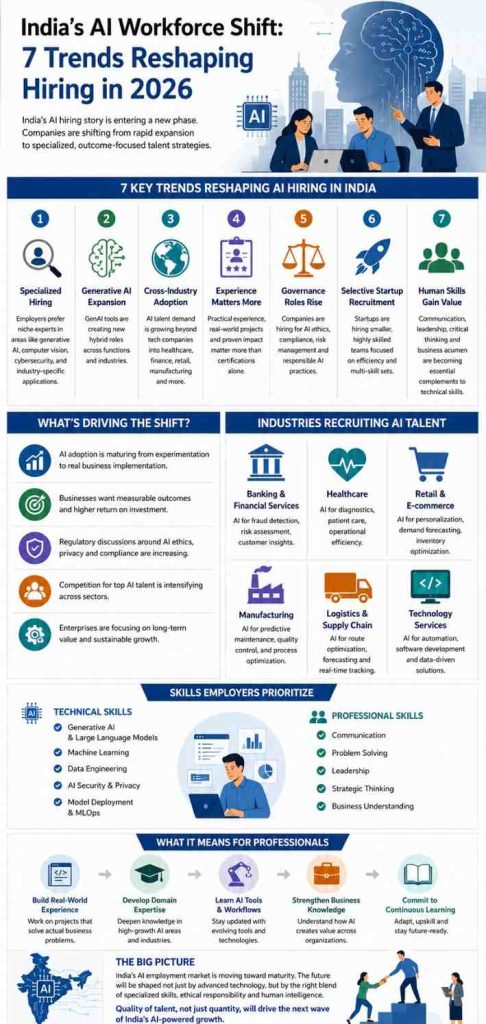
Trend 5: AI Governance and Compliance Roles Are Growing
As AI adoption accelerates, concerns around ethics, privacy, transparency, and regulatory compliance are becoming more prominent.
Organizations are facing increased scrutiny regarding how AI systems are trained, deployed, and monitored. Governments worldwide are also exploring regulatory frameworks aimed at ensuring responsible AI use.
Consequently, companies are expanding hiring in areas related to AI governance, risk management, data privacy, model auditing, and responsible AI implementation.
These roles often require a combination of legal, policy, business, and technical expertise, creating new career pathways that did not exist at scale only a few years ago.
Trend 6: Startups Are Hiring More Selectively
India’s startup ecosystem continues to play an important role in AI innovation. Yet venture capital markets have become more disciplined compared to the aggressive funding environment seen during previous growth cycles.
Many AI startups are focusing on operational efficiency and sustainable growth. Rather than rapidly expanding headcount, they are prioritizing smaller teams with highly skilled employees.
This approach has increased competition for startup positions while simultaneously raising expectations regarding productivity and technical competence.
For professionals, startup opportunities remain attractive but often require broader skill sets and a greater willingness to work across multiple functions.
Trend 7: Human Skills Are Becoming More Important
Despite advances in automation, employers increasingly emphasize skills that machines cannot easily replicate.
Communication, critical thinking, problem-solving, leadership, creativity, and strategic decision-making are becoming essential complements to technical expertise.
Organizations deploying AI technologies frequently need professionals who can explain complex concepts to non-technical stakeholders, align AI initiatives with business goals, and manage organizational change.
This growing emphasis on human-centered capabilities reflects a broader understanding that successful AI implementation depends on people as much as technology.
What This Means for Job Seekers
The changing nature of AI hiring presents both opportunities and challenges.
On one hand, demand for skilled professionals remains strong as businesses continue investing in digital transformation. On the other hand, employers are becoming increasingly selective regarding qualifications, experience, and specialization.
Candidates seeking long-term success in the AI workforce may benefit from focusing on three areas:
- Building practical project experience.
- Developing expertise in a specific AI domain.
- Strengthening communication and business skills alongside technical capabilities.
Those who combine these strengths are likely to remain competitive as hiring requirements continue evolving.
Why the Shift Matters for India’s Economy
The transformation of AI hiring has implications beyond individual careers.
India’s ambition to become a global technology and innovation hub depends heavily on the development of a future-ready workforce. As organizations adopt more advanced AI systems, the quality of talent may become a more important factor than sheer workforce size.
The shift also highlights the need for educational institutions, training providers, and policymakers to align learning programs with emerging industry demands. Ensuring that graduates possess both technical and practical skills will be critical for sustaining growth in the AI economy.
At the same time, businesses that successfully integrate AI while investing in workforce development could gain significant competitive advantages in domestic and global markets.
As India’s digital transformation enters a more mature phase, the AI hiring story is no longer simply about creating more jobs. It is increasingly about creating the right jobs, developing specialized expertise, and preparing workers for an economy where human capabilities and artificial intelligence are expected to work side by side. The companies and professionals that adapt to this new reality are likely to shape the next chapter of India’s technology-driven growth.
Highlights
- AI hiring in India is shifting from rapid expansion to a more specialized and outcome-focused approach.
- Employers increasingly prefer candidates with expertise in areas such as generative AI, cybersecurity, computer vision, and industry-specific applications.
- Practical project experience is becoming more important than certifications alone during recruitment.
- Demand for AI talent is expanding beyond technology firms into healthcare, finance, retail, and manufacturing sectors.
- New opportunities are emerging in AI governance, compliance, ethics, and risk management roles.
- Startups are hiring more selectively, prioritizing efficiency and specialized skills over large workforce growth.
- Human skills such as communication, leadership, and strategic thinking remain critical in AI-driven workplaces.
FAQ
1. Why is India’s AI hiring market changing?
India’s AI hiring market is maturing as companies move from experimentation to practical implementation. Employers are focusing on measurable business outcomes rather than expanding AI teams indiscriminately.
2. Which AI skills are currently in demand?
Skills related to generative AI, machine learning, large language models, cybersecurity, data engineering, computer vision, and AI governance are attracting significant employer interest.
3. Are AI jobs still growing in India?
Yes. Demand remains strong, but hiring is becoming more targeted. Companies are seeking specialized talent and practical expertise rather than hiring broadly.
4. Do certifications help in securing AI jobs?
Certifications can support learning and credibility, but employers increasingly prioritize hands-on experience, project portfolios, and real-world problem-solving capabilities.
5. Which industries are hiring AI professionals?
Apart from technology companies, sectors such as banking, healthcare, retail, manufacturing, logistics, and financial services are actively adopting AI solutions and recruiting talent.
6. What role does generative AI play in hiring trends?
Generative AI is creating new job categories and changing existing roles by requiring professionals who can manage, evaluate, and integrate AI systems into business operations.
7. Are startups still recruiting AI talent?
Yes, but many startups are adopting a more selective hiring strategy, focusing on highly skilled professionals who can contribute across multiple functions.
8. What are AI governance roles?
These positions focus on responsible AI deployment, regulatory compliance, privacy protection, risk management, and ensuring ethical use of artificial intelligence systems.
9. Will AI replace human workers?
While AI can automate certain tasks, many organizations view it as a tool that augments human capabilities. Demand remains strong for professionals with technical expertise and strong human-centered skills.
10. What should aspiring AI professionals focus on?
Building practical experience, developing specialization in a high-demand domain, and strengthening communication and business understanding can improve long-term career prospects.
Edited By E. Devanshi varma
Also Read: IPL Honey-Trap Row Sparks 7 Big Questions Before Playoffs
Follow us on Google News: Click Here