

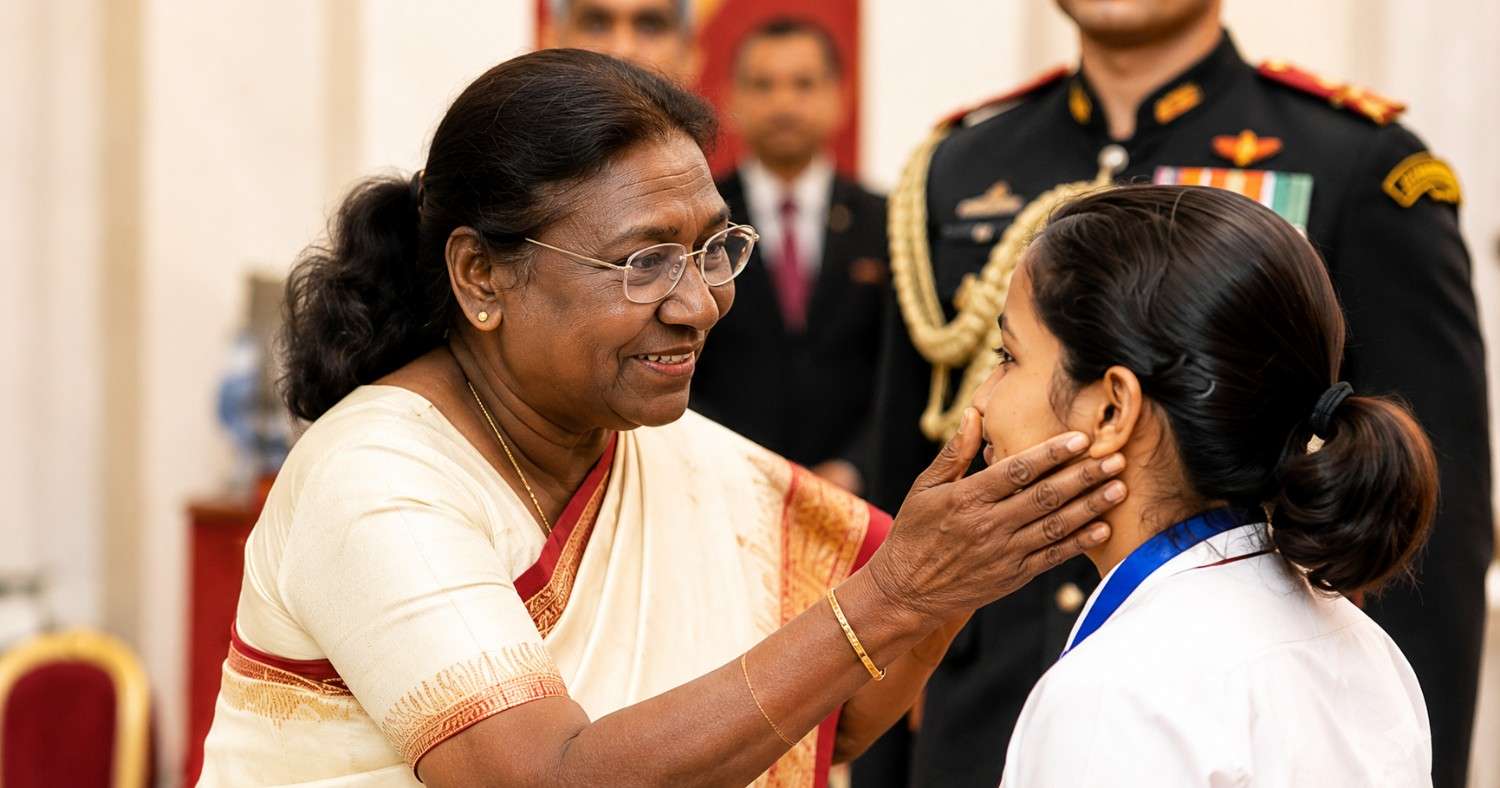
President Droupadi Murmu’s heartfelt gesture during a public event has drawn widespread appreciation across India, highlighting compassion, humility, and the human side of leadership.
In a political environment often dominated by policy debates, electoral calculations, and institutional responsibilities, moments of genuine human connection can leave a lasting impression on the public. Such a moment recently emerged involving President Droupadi Murmu, whose compassionate interaction during a public engagement attracted widespread attention and admiration.
The gesture, widely shared across digital platforms and discussed by citizens from different walks of life, resonated not because of its political significance but because of its emotional sincerity. Many observers viewed the moment as an example of leadership that extends beyond official duties and ceremonial responsibilities.
As India’s Head of State, President Murmu occupies one of the country’s highest constitutional offices. While the presidency is largely defined by constitutional obligations, symbolic acts often carry substantial meaning. Public reactions to the recent interaction suggest that citizens continue to value empathy, accessibility, and humility in public leadership.
Why the Moment Resonated
Public figures are constantly observed through the lens of their official roles. However, it is often the smaller, unscripted moments that shape public perception most strongly.
In this instance, the President’s interaction appeared to transcend protocol and formalities. Citizens responding online highlighted the warmth and sincerity reflected in the gesture. Many described it as a reminder that public office can remain deeply connected to ordinary human experiences.
Leadership scholars frequently note that trust in institutions is strengthened when citizens perceive leaders as relatable and empathetic. While policy decisions and governance outcomes remain critical, symbolic acts can reinforce emotional connections between institutions and the people they serve.
The widespread response suggests that many Indians interpreted the moment through that lens.
President Murmu’s Journey Continues to Inspire
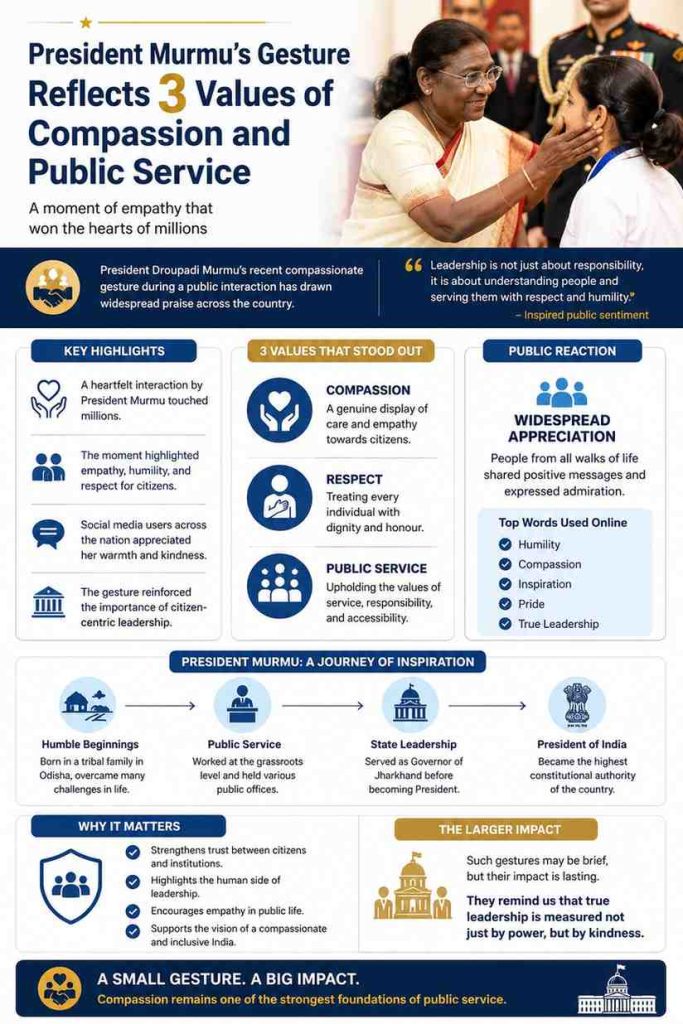
The public reaction may also be linked to President Murmu’s personal journey, which has often been cited as one of resilience and perseverance.
Before assuming the presidency, Murmu served in various public offices and built a reputation for grassroots engagement. Her rise to the highest constitutional position in the country has been viewed by many as a reflection of India’s democratic inclusiveness.
Coming from a tribal community and overcoming personal hardships throughout her life, Murmu’s story has frequently been associated with determination and public service. As a result, gestures perceived as compassionate often attract greater attention because they align with an image that many citizens already associate with her leadership style.
This context helps explain why the recent moment generated emotional responses across diverse sections of society.
The Human Dimension of Public Leadership
Modern political discourse increasingly focuses on measurable outcomes such as economic growth, infrastructure development, public welfare programs, and administrative efficiency. While these factors remain essential, leadership also carries an emotional dimension.
Citizens often look to national figures for reassurance during moments of uncertainty and inspiration during times of change. Acts that demonstrate kindness or respect can therefore have a broader symbolic impact.
Political analysts have long observed that public trust is influenced not only by institutional performance but also by perceptions of character. Gestures that appear authentic can strengthen confidence in public institutions by making them feel more approachable and humane.
The reaction to President Murmu’s interaction reflects this broader reality.
Social Media Amplifies Symbolic Moments
The digital era has transformed how citizens engage with public figures. Moments that may once have been witnessed by a limited audience can now reach millions within hours.
Videos, photographs, and eyewitness accounts are frequently shared across multiple platforms, allowing emotional interactions to generate widespread discussion. In many cases, these moments spark conversations that extend beyond the specific event itself.
The President’s gesture became part of a broader discussion about leadership qualities that citizens value. Users praised traits such as humility, dignity, patience, and compassion, with many commenting that these characteristics are essential for public representatives.
The rapid spread of the story demonstrates how digital platforms increasingly shape narratives around governance and leadership.
Compassion as a Public Value
Compassion is often discussed in personal contexts, but it also plays an important role in public life.
Government institutions interact with millions of people every day. Citizens frequently judge these institutions not only by their effectiveness but also by how they treat individuals. Respectful and empathetic engagement can improve public confidence and strengthen civic trust.
Experts in public administration argue that citizen-centric governance requires both efficiency and sensitivity. While policies establish frameworks for service delivery, human interactions often determine how those policies are experienced on the ground.
Moments such as the one involving President Murmu can therefore serve as reminders of the importance of compassion within public institutions.
A Symbol Beyond Politics
One notable aspect of the public response was its relatively non-partisan nature. Much of the discussion centered on personal values rather than political affiliations or policy debates.
Citizens from different backgrounds appeared to interpret the gesture as an example of universal qualities that transcend political divisions. Respect, kindness, and empathy are values that resonate broadly, regardless of ideological differences.
Such moments can contribute positively to public discourse by shifting attention toward shared human experiences. In an era where political conversations can often become polarized, stories rooted in compassion frequently attract wider appreciation.
The Broader Significance
While the gesture itself may have lasted only a brief moment, its significance lies in the reaction it generated.
The episode highlights how citizens continue to expect integrity, humility, and humanity from public leaders. It also underscores the enduring importance of symbolic leadership in democratic societies.
Constitutional offices carry immense responsibility, but they also represent national values and aspirations. Public interactions that reflect dignity and empathy can reinforce those ideals in meaningful ways.
For many observers, the response to President Murmu’s gesture was less about a single event and more about what it represented—a reminder that leadership is not only exercised through institutions and authority but also through everyday acts of respect and compassion.
As public conversations continue to evolve in the digital age, moments that reflect these qualities are likely to remain influential. They offer citizens a glimpse into the human side of leadership and reinforce the idea that public service, at its core, is about serving people with understanding and dignity.
Highlights
- President Droupadi Murmu’s recent public gesture drew widespread appreciation across social media and public circles.
- The moment highlighted values often associated with public service, including empathy, humility, and respect for citizens.
- Observers described the interaction as a reminder of the human side of constitutional leadership.
- The incident generated positive discussions about leadership styles in India’s public institutions.
- Public reactions focused on the symbolic importance of accessibility and compassion in high office.
- The episode added to growing conversations about citizen-centric governance and public trust.
FAQ
1. What was the gesture involving President Droupadi Murmu?
President Murmu was widely praised for a compassionate public interaction that many citizens viewed as a reflection of empathy, humility, and respect.
2. Why did the incident attract public attention?
The gesture stood out because it highlighted the human side of leadership and generated positive reactions across social media and public discussions.
3. Who is President Droupadi Murmu?
Droupadi Murmu is the President of India and the country’s constitutional Head of State. She assumed office in July 2022.
4. Why do symbolic gestures by public leaders matter?
Such gestures can influence public perception, strengthen trust, and demonstrate values such as compassion, accessibility, and respect.
5. How did people react to the incident?
Many citizens praised the President’s humility and warmth, describing the interaction as inspiring and emotionally meaningful.
6. Does symbolic leadership have an impact on governance?
While governance is primarily measured through policies and outcomes, symbolic leadership can help strengthen public confidence in institutions.
7. What qualities were most frequently associated with the President’s gesture?
Public reactions commonly referenced empathy, kindness, humility, dignity, and compassion.
8. Why is President Murmu’s personal journey often discussed?
Her rise from a tribal community background to India’s highest constitutional office is widely viewed as a significant democratic achievement.
Edited By E. Devanshi varma
Also Read: IPL Honey-Trap Row Sparks 7 Big Questions Before Playoffs
Follow us on Google News: Click Here