


India’s artificial intelligence industry is entering a new phase of growth that many analysts believe is unfolding faster than expected. Over the last two years, AI has moved beyond experimental technology projects and become a major force influencing businesses, startups, education, government initiatives, and consumer applications across the country.
The rapid rise of generative AI platforms, automation tools, machine learning systems, and AI-driven analytics has triggered intense investment activity among technology firms operating in India. Industry experts say the country is now emerging as one of the most important AI growth markets globally because of its combination of engineering talent, expanding digital infrastructure, large internet user base, and rising startup ecosystem.
While AI development has become a global race involving major economies such as the United States and China, India’s momentum is attracting attention for a different reason: scale. With millions of digital users coming online, businesses are finding new opportunities to apply AI in customer support, healthcare diagnostics, financial services, agriculture, logistics, cybersecurity, and education technology.
AI Adoption Is Moving Beyond Large Tech Companies
For years, artificial intelligence adoption in India was largely concentrated among large IT firms and multinational technology companies. That pattern is now changing rapidly.
Small and medium-sized businesses are increasingly experimenting with AI-powered tools to automate routine tasks, improve customer engagement, and reduce operational costs. Generative AI platforms capable of producing text, visuals, coding assistance, and business insights are becoming more accessible, allowing even smaller organizations to adopt advanced digital workflows without building expensive infrastructure from scratch.
Indian software service providers are also reshaping their strategies around AI integration. Many firms that traditionally focused on outsourcing and enterprise IT support are now repositioning themselves as AI transformation partners for global clients.
This transition is significant because India’s IT services sector has historically been one of the country’s largest export engines. As businesses worldwide seek AI implementation support, Indian firms are expected to play a major role in building, managing, and scaling these systems.
Startups Are Driving Aggressive Innovation
One of the strongest indicators of India’s AI acceleration is the rapid expansion of AI-focused startups.
Venture capital investors have shown growing interest in Indian startups building AI tools for industries ranging from healthcare to retail analytics. Companies are developing multilingual AI systems, voice-based assistants, automation software, and industry-specific AI platforms designed for local market challenges.
India’s linguistic diversity is creating unique opportunities in AI development. Several startups are focusing on regional-language AI models capable of serving users in Hindi, Tamil, Telugu, Bengali, Marathi, and other Indian languages. This could significantly expand digital accessibility in non-English-speaking regions.
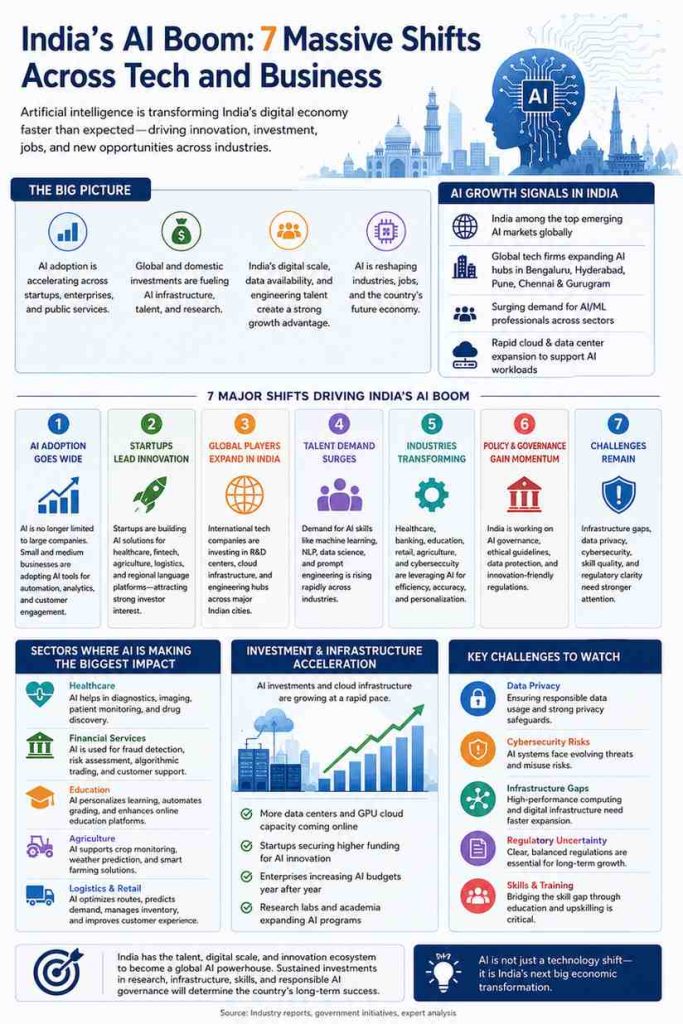
Healthcare is another major growth area. AI-powered diagnostic platforms are helping hospitals improve imaging analysis, patient triage, and predictive healthcare monitoring. In agriculture, startups are experimenting with AI systems that analyze crop health, weather conditions, irrigation needs, and soil quality to assist farmers in improving productivity.
Financial technology companies are also increasing AI deployment for fraud detection, risk analysis, credit assessment, and customer service automation.
Global Companies Are Expanding AI Operations in India
India’s growing role in AI development is also being reinforced by major international technology companies expanding their operations in the country.
Global firms are investing heavily in engineering centers, cloud infrastructure, research labs, and AI development hubs in Indian cities including Bengaluru, Hyderabad, Pune, Chennai, and Gurugram. These investments are creating high demand for engineers, data scientists, machine learning specialists, cybersecurity experts, and AI product managers.
Technology leaders increasingly view India not just as a back-office outsourcing destination but as a strategic innovation market capable of contributing to core product development.
Cloud computing providers are simultaneously expanding data center infrastructure to support rising AI workloads. Since AI systems require large-scale computing power and data processing capabilities, cloud expansion is becoming a crucial part of the country’s digital transformation ecosystem.
Industry analysts believe India could become one of the world’s largest AI talent hubs if educational institutions and corporate training programs continue scaling at the current pace.
AI Talent Demand Is Reshaping the Job Market
The rapid growth of AI is significantly affecting India’s employment landscape.
Companies across industries are now competing for professionals with expertise in machine learning, prompt engineering, natural language processing, data analytics, automation systems, and AI ethics. Online learning platforms and universities are responding by expanding AI certification programs and specialized courses.
At the same time, concerns are growing around workforce disruption.
Automation technologies are expected to reduce dependence on repetitive and process-driven roles in sectors such as customer support, data entry, and basic software maintenance. However, economists argue that AI may also create entirely new categories of employment focused on system management, AI governance, data operations, and human-AI collaboration.
The transition could reshape the skills employers prioritize in the coming years. Communication, analytical thinking, domain expertise, and adaptability are increasingly being viewed as critical alongside technical knowledge.
Many businesses are already retraining existing employees to work with AI-assisted systems rather than replacing them outright.
Government Policies Could Influence the Next Growth Phase
India’s policymakers are also paying closer attention to artificial intelligence as the technology becomes strategically important for economic growth and national competitiveness.
Government-backed digital initiatives, including digital identity systems, online payment infrastructure, and public digital platforms, have already created an environment that supports large-scale data-driven innovation.
Now, discussions are expanding around AI governance, regulation, ethical safeguards, cybersecurity protections, and responsible deployment standards.
One major challenge involves balancing innovation with regulation. Policymakers face increasing pressure to encourage AI investment while also addressing concerns related to misinformation, deepfakes, data privacy, algorithmic bias, and employment disruption.
Experts say India’s approach to AI governance could influence how quickly international investors expand partnerships within the country.
Another important issue is semiconductor infrastructure. Since AI systems rely heavily on advanced chips and computing hardware, India has been exploring ways to strengthen domestic electronics manufacturing and reduce dependence on global supply chain vulnerabilities.
Why India’s Scale Gives It a Unique Advantage
Several factors are contributing to India’s unusually rapid AI expansion.
The country’s massive population of internet users generates enormous amounts of digital activity, creating valuable datasets that can help train AI systems. Smartphone penetration and low-cost mobile internet have further accelerated digital participation across urban and rural regions.
India also produces one of the world’s largest pools of engineering and software graduates annually. Although skill quality varies significantly, the sheer size of the workforce gives technology companies access to scalable technical talent.
In addition, the startup ecosystem has matured substantially over the past decade. Indian entrepreneurs now have greater access to funding networks, accelerator programs, cloud infrastructure, and global technology partnerships compared to earlier technology cycles.
The widespread adoption of digital payments and e-commerce platforms has also created data-rich environments where AI tools can improve personalization, fraud detection, logistics optimization, and financial analysis.
Challenges Could Slow Momentum if Not Addressed
Despite strong growth, India’s AI ecosystem still faces structural challenges.
Infrastructure gaps remain a concern, particularly outside major metropolitan areas. Reliable high-speed internet access, advanced computing infrastructure, and research funding remain unevenly distributed.
AI research output from India also trails leading global innovation hubs in some advanced areas. Experts argue that long-term success will depend not only on AI adoption but also on original research, foundational model development, and intellectual property creation.
Data privacy concerns are becoming increasingly important as businesses gather larger volumes of consumer information for AI training and analytics. Regulatory clarity may become essential for maintaining public trust.
There are also concerns around misinformation and synthetic media. The rapid spread of AI-generated content has intensified debates about verification systems, platform accountability, and digital literacy.
Cybersecurity risks could grow as AI systems become more deeply integrated into financial networks, healthcare platforms, and critical infrastructure.
The Global AI Race Is Creating Pressure to Move Faster
India’s AI expansion is taking place during an intense global competition for technological leadership.
Governments and corporations worldwide are investing billions into artificial intelligence infrastructure, semiconductor manufacturing, cloud computing, and advanced research models. As this race accelerates, countries are increasingly viewing AI as both an economic and strategic capability.
For India, the current moment represents both an opportunity and a challenge.
If investments in infrastructure, education, research, and governance continue growing, the country could emerge as one of the world’s largest AI-driven digital economies over the next decade. But sustaining that momentum may require stronger coordination between industry leaders, academic institutions, regulators, and technology policymakers.
The speed of India’s AI expansion suggests that the technology is no longer confined to future projections or experimental innovation labs. It is already reshaping how businesses operate, how services are delivered, and how the broader digital economy functions. The coming years are likely to determine whether India can convert its current AI momentum into long-term technological leadership.
Highlights
- India’s artificial intelligence sector is expanding rapidly across startups, enterprises, education, and public services.
- Global technology companies and domestic firms are increasing investments in AI infrastructure, talent, and research operations in India.
- The rise of affordable internet, digital payments, and large-scale data availability is accelerating AI adoption nationwide.
- Indian startups are using AI in healthcare, finance, education, agriculture, logistics, and customer service industries.
- Demand for AI-skilled professionals has surged as companies compete to build automation and generative AI capabilities.
- Policymakers are also exploring AI governance frameworks focused on innovation, safety, and digital competitiveness.
FAQ
What is driving India’s AI boom?
India’s AI growth is being driven by expanding internet access, digital payments infrastructure, rising startup activity, cloud computing growth, and increased investment from both domestic and global technology companies.
Which industries in India are adopting AI the fastest?
Healthcare, financial technology, customer service, logistics, education technology, retail, cybersecurity, and agriculture are among the sectors seeing rapid AI adoption.
Why are global companies investing in AI operations in India?
India offers a large engineering workforce, a rapidly expanding digital economy, lower operational costs compared to some global markets, and strong long-term growth potential.
How is AI affecting jobs in India?
AI is automating some repetitive tasks while also creating demand for new skills in machine learning, analytics, cybersecurity, and AI system management. Many companies are investing in employee reskilling programs.
What role do startups play in India’s AI ecosystem?
Startups are building AI tools for local and global markets, especially in regional language processing, healthcare technology, financial services, and automation platforms.
Why is multilingual AI important in India?
India’s linguistic diversity creates demand for AI systems that can operate in regional languages, helping improve accessibility for millions of non-English-speaking users.
What challenges could slow India’s AI growth?
Infrastructure gaps, limited advanced semiconductor manufacturing, uneven research funding, data privacy concerns, and regulatory uncertainty could affect long-term growth.
Is the Indian government creating AI regulations?
Policymakers are increasingly discussing AI governance frameworks related to safety, privacy, ethical standards, misinformation, and responsible deployment practices.
How important is cloud infrastructure for AI development?
AI systems require significant computing power and data processing capabilities. Cloud infrastructure and data centers are therefore critical for scaling AI applications.
Could India become a global AI leader?
Industry experts believe India has strong potential due to its talent pool, startup ecosystem, and digital scale, though sustained investment in research, infrastructure, and governance will be important.
Edited By E. Devanshi varma
Also Read: Assam Assembly Polls See 7 Major Highlights as Turnout Peaks, Counting Set for May 4
Follow us on Google News: Click Here