

New Delhi, April 28:
Aam Aadmi Party (AAP) national convenor Arvind Kejriwal on Tuesday announced that he will no longer take part in ongoing court proceedings related to the Delhi excise policy case before a particular bench of the Delhi High Court. Framing his decision as a matter of conscience, he said his only remaining option was to adopt “satyagraha,” invoking the philosophy associated with Mahatma Gandhi.
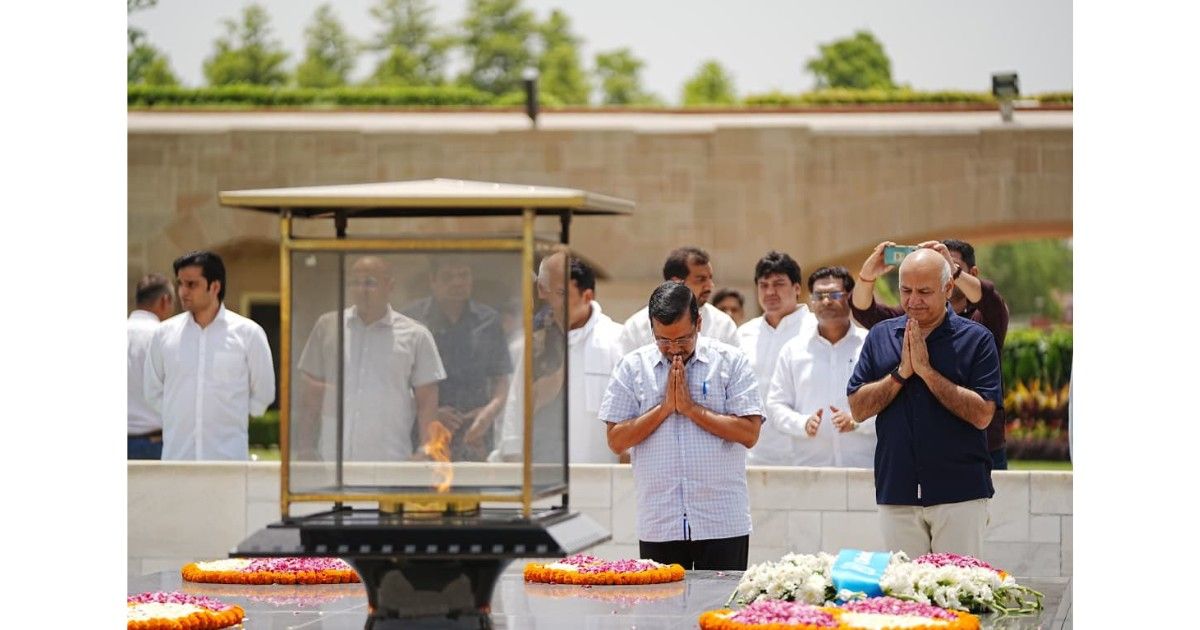
Kejriwal, accompanied by senior party leaders including Manish Sisodia, visited Raj Ghat in New Delhi earlier in the day to pay tribute to Gandhi. The symbolic gesture was followed by a public reiteration of his stance, which he described as a principled refusal to continue engaging in what he perceives as an unfair judicial process.
Key Announcements and Developments
- Kejriwal stated he will not appear—either personally or through legal representation—before the bench currently hearing the matter.
- He has written to Justice Swarna Kanta Sharma of the Delhi High Court, expressing his reservations about the proceedings.
- The AAP leader clarified that his decision is based on “inner conscience” and not directed at any individual judge.
- He emphasized that he retains faith in the judiciary as an institution and may pursue remedies before higher courts if required.
- The move has triggered contrasting political reactions, with supporters calling it a moral stand and critics terming it a political tactic.
A Moral Position Rooted in ‘Satyagraha’
Speaking to reporters after visiting Raj Ghat, Kejriwal said that his decision stems from a deep moral dilemma rather than a conventional legal strategy. He described “satyagraha” as a form of non-cooperation rooted in ethical conviction, rather than defiance of the law.
According to him, participating in proceedings despite doubts about fairness would contradict his principles. He stressed that his stance should not be interpreted as a rejection of the judiciary as a whole, but rather as a response to specific circumstances that have led him to question the impartiality of the process in this instance.
The concept of satyagraha, historically associated with India’s freedom movement, refers to peaceful resistance based on truth and moral integrity. By invoking this term, Kejriwal appears to be positioning his decision within a broader philosophical and political framework, rather than limiting it to a legal dispute.
Official Statement and Court Communication
In his letter addressed to Justice Swarna Kanta Sharma, Kejriwal wrote that his “conscience does not permit” him to continue participating in the proceedings. He also cited what he described as a “deep sense of doubt” regarding the fairness of the process.
He clarified that his concerns are not personal and do not question the integrity of any individual. Instead, he framed them as arising from a perceived erosion of visible impartiality—an important principle in judicial functioning.
Kejriwal also pointed out that he has previously benefited from judicial intervention, noting that he was granted bail in the same matter. This, he said, reinforces his belief in the system even as he raises concerns about the current situation.
Legal experts note that while individuals have the right to question judicial processes, non-participation in court proceedings can have procedural implications. Courts typically expect litigants to present their case through established legal channels, and absence may affect how the matter progresses.
Legal Context of the Delhi Excise Policy Case
The Delhi excise policy case has been a significant political and legal issue over the past few years. It revolves around allegations of irregularities in the formulation and implementation of a now-scrapped liquor policy introduced by the Delhi government.
Investigative agencies have alleged procedural lapses and possible financial misconduct, while AAP leaders have consistently denied wrongdoing, describing the case as politically motivated.
Kejriwal’s involvement in the matter, along with that of other party leaders, has kept the case in public focus. His earlier arrest and subsequent bail added to the political and legal complexity of the situation.
The current development marks a departure from standard legal practice, where accused individuals typically continue to engage with court proceedings while contesting charges.
Political Reactions and Divergent Views
Kejriwal’s announcement has drawn sharp reactions across the political spectrum.
Supporters within the AAP have framed the move as a principled stand against what they allege is a biased process. They argue that invoking satyagraha reflects a commitment to democratic values and non-violent resistance.
Critics, however, have questioned the timing and intent of the decision. Some opposition leaders have described it as a political strategy aimed at mobilizing public opinion and shifting focus from legal issues to a broader narrative of institutional trust.
Legal commentators have also weighed in, noting that while moral arguments can shape public discourse, courts operate within defined procedural frameworks. The effectiveness of such a stance, they say, will depend on how the judiciary chooses to respond.
Broader Questions on Institutional Trust
Beyond the immediate case, Kejriwal’s decision has brought renewed attention to the issue of public trust in institutions. His remarks highlight a key tension: the balance between respecting judicial authority and raising concerns about perceived fairness.
In democratic systems, courts derive legitimacy not only from legal authority but also from public confidence in their impartiality. Any expression of doubt by a prominent political figure can therefore have wider implications.
At the same time, legal experts caution that such concerns are typically addressed through formal mechanisms, such as appeals or requests for transfer of cases, rather than withdrawal from proceedings.
Kejriwal has indicated that he may still approach the Supreme Court if necessary, suggesting that he does not intend to abandon legal remedies altogether.
Public Impact and What It Means
For the general public, the development raises important questions about how political leaders engage with the judicial system.
On one hand, Kejriwal’s stance may resonate with those who view it as an assertion of ethical accountability. On the other, it may also create uncertainty about how such actions align with established legal norms.
The case itself continues to hold significance for governance and policy-making, particularly in areas like regulatory frameworks and administrative transparency. The outcome could influence how similar policies are designed and scrutinized in the future.
For AAP supporters, the move may reinforce the party’s narrative of standing against perceived institutional challenges. For critics, it may serve as a point of debate about adherence to legal processes.
The Road Ahead
As the situation unfolds, attention will likely shift to how the Delhi High Court responds to Kejriwal’s decision not to participate in proceedings before the current bench.
Possible scenarios include the continuation of hearings in his absence, legal consequences related to non-appearance, or further appeals to higher courts. Much will depend on procedural considerations and judicial discretion.
Kejriwal’s indication that he may approach the Supreme Court leaves open the possibility of further legal developments. This suggests that while he has stepped back from one stage of the process, the broader legal battle is far from over.
At a political level, the issue is expected to remain part of ongoing debates around governance, accountability, and institutional trust. The invocation of satyagraha adds a symbolic dimension that extends beyond the courtroom, potentially shaping public discourse in the coming weeks.
Inputs and images : Hindusthan Samachar
Edited By E. Devanshi varma
Also Read: BJP Cites 10 Years of Women-Centric Reforms at Varanasi Event, Nitin Nabin Praises Modi
Follow us on Google News: Click Here