

New Delhi, May 4 — Delhi Chief Minister Rekha Gupta marked the Bharatiya Janata Party’s (BJP) projected electoral success with a symbolic celebration at the Delhi Secretariat on Sunday. The gathering featured traditional Bengali snacks such as jhal-muri and rasgulla, reflecting the party’s apparent strong performance in multiple states, including a decisive lead in West Bengal, where counting trends were still being finalised at the time.
The event, attended by several cabinet ministers, blended political messaging with cultural symbolism, as leaders publicly expressed optimism about the party’s expanding footprint across regions.
Festive Gathering Reflects Political Confidence
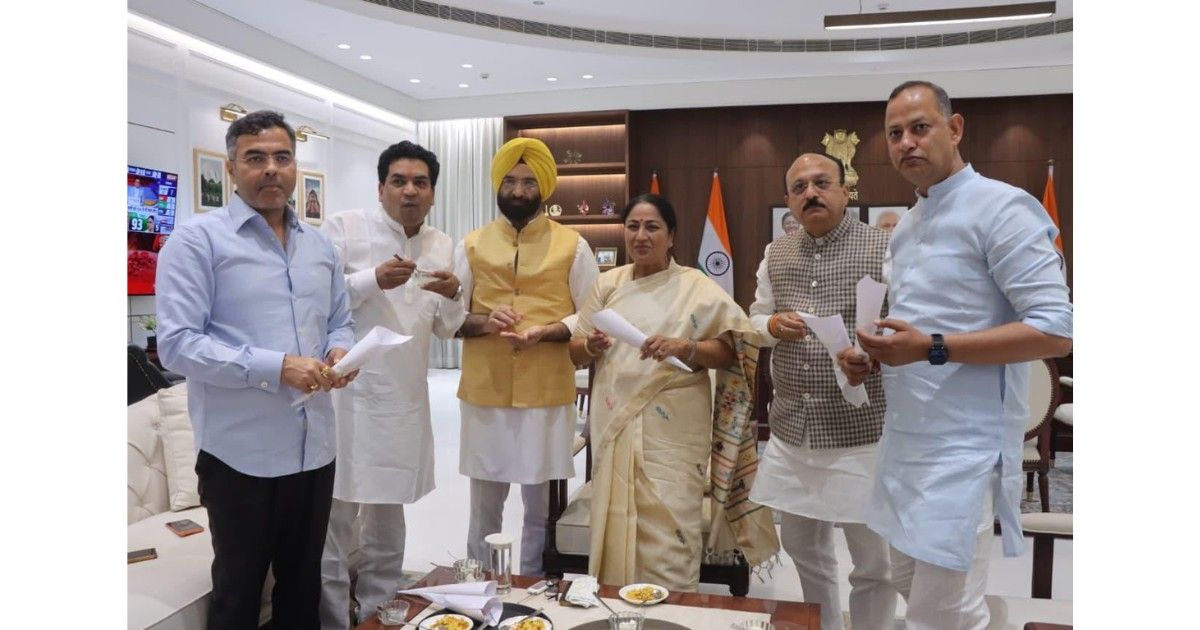
The informal celebration stood out for its simplicity and symbolism. Chief Minister Gupta personally served jhal-muri — a popular street snack from Kolkata — along with rasgullas, a well-known Bengali sweet, to her colleagues. The choice of food was widely seen as a gesture connecting Delhi’s political leadership with developments in eastern India.
Among those present were Education Minister Ashish Sood, Public Works Department Minister Parvesh Sahib Singh, Environment Minister Manjinder Singh Sirsa, Tourism Minister Kapil Mishra, and Social Welfare Minister Ravindra Indrajeet Singh.
The atmosphere at the Secretariat was relaxed yet politically charged, with leaders engaging in conversations about the election trends and the broader implications for the party.
Ministers Share Reactions on Social Media
Following the gathering, several ministers took to social media to express their views on the election outcome and the significance of the moment.
Ashish Sood described the celebration as a fusion of culture and political success. In his remarks, he linked the symbolic foods to what he termed the “sweet taste of victory,” attributing the party’s performance to the leadership of Prime Minister Narendra Modi. He emphasised that the results reflected public trust in governance focused on development and long-term vision.
Parvesh Sahib Singh, meanwhile, framed the outcome as a rejection of opposition alliances. He argued that voters, particularly in West Bengal, had chosen stability and development over what he described as fragmented political alternatives. His comments highlighted the BJP’s narrative that its governance model resonates with voters seeking consistent policy direction.
Manjinder Singh Sirsa offered a perspective centred on voter awareness. He stated that the electorate in West Bengal had carefully evaluated their choices and identified the BJP as a credible alternative capable of addressing governance challenges. His remarks suggested a shift in political perception within the state.
Kapil Mishra took a more ideological stance, interpreting the trends as a reaffirmation of cultural and religious identity in politics. He argued that the results underscored the importance of respecting traditional values in governance, framing the outcome as aligned with the BJP’s broader ideological positioning.
Symbolism of Food in Political Messaging
The use of jhal-muri and rasgulla was not merely a culinary choice but a deliberate political signal. Both items are closely associated with West Bengal’s cultural identity, and their presence at the Delhi Secretariat carried layered meaning.
Political observers note that such symbolism often serves to communicate a party’s intent to connect with diverse regional identities. In this case, the BJP’s celebration appeared to reflect its efforts to strengthen its presence in eastern India, a region historically dominated by regional parties.
The gesture also highlights how political communication increasingly incorporates cultural elements to resonate with a wider audience. By choosing food as a medium, the leaders conveyed a message that extends beyond formal statements, making it more accessible and relatable.
Broader Electoral Context
The celebration comes against the backdrop of Assembly elections held across multiple states and one Union Territory. While official results were still being consolidated, early trends indicated a strong performance by the BJP in several regions.
West Bengal, in particular, has been a politically significant state where the BJP has been working to expand its base. The state has traditionally been dominated by regional parties, making any shift in electoral dynamics noteworthy.
The party’s apparent gains are being interpreted as part of a broader national trend, where it continues to consolidate support across different regions. Analysts suggest that factors such as central leadership, organisational strength, and campaign strategies have played a role in shaping these outcomes.
Political Messaging and Narrative Building
The statements made by ministers during and after the celebration reflect a consistent narrative strategy. Emphasis on development, stability, and leadership has been central to the BJP’s messaging in recent years.
At the same time, the inclusion of cultural and ideological elements indicates an attempt to appeal to a diverse voter base. By combining governance-focused arguments with identity-based messaging, the party seeks to address multiple dimensions of voter expectations.
The Delhi event serves as an example of how political communication operates on both symbolic and substantive levels. While the gathering itself was informal, the messages conveyed were aligned with the party’s broader electoral narrative.
Public Impact and Interpretation
For the general public, such celebrations may appear as routine political events. However, they also offer insights into how parties interpret and present electoral outcomes.
The emphasis on cultural symbolism suggests an effort to build connections across regions, potentially influencing how voters perceive national parties in local contexts. This approach may contribute to shaping political discourse, especially in states where electoral competition is intensifying.
Additionally, the public statements by ministers provide a glimpse into the policy and ideological directions that may guide future governance. By highlighting themes such as development and stability, leaders signal their priorities to both supporters and critics.
What Lies Ahead
As counting continues and official results are confirmed, the political landscape is expected to become clearer. The BJP’s performance in these elections will likely influence its strategy for upcoming polls, as well as its governance agenda at both state and national levels.
The celebration at the Delhi Secretariat, while symbolic, underscores the importance of perception in politics. It reflects confidence within the party ranks and sets the tone for how the results are being framed publicly.
In the coming days, attention will shift to detailed analyses of the results, including voter behaviour, regional variations, and the performance of different parties. These insights will be crucial in understanding the evolving dynamics of Indian politics.
The event also highlights how political narratives are constructed in real time, with leaders using both traditional and unconventional methods to communicate their message. As such, it offers a snapshot of the intersection between culture, communication, and राजनीति in contemporary India.
Inputs and images : Hindusthan Samachar
Edited By E. Devanshi varma
Also Read: Assam Assembly Polls See 7 Major Highlights as Turnout Peaks, Counting Set for May 4
Follow us on Google News: Click Here